Consumer Tech Guide What Is a GaN Charger?
The Ultimate Buying Guide |
What Is a GaN Charger?A GaN charger is a power adapter that uses gallium nitride (GaN) semiconductors instead of traditional silicon to convert mains electricity into safe charging voltage. GaN transistors switch electricity at higher frequencies with less heat loss, allowing the same charging power to be delivered from a significantly smaller and lighter device — typically 40 to 70 percent smaller than an equivalent silicon charger. Key Facts at a GlanceGaN chargers operate at switching frequencies above 1 MHz — versus 50–100 kHz in silicon chargers — reducing transformer core size dramatically. A 65W GaN charger typically measures under 50 mm in height; an equivalent silicon charger measures 70–90 mm. Thermal efficiency: GaN chargers dissipate 20–30% less heat than silicon equivalents at the same output power, meaning less energy wasted as heat. USB Power Delivery (USB-PD) 3.1, supported by most modern GaN chargers, delivers up to 240W — enough to charge a full laptop, tablet, and smartphone simultaneously. EU Ecodesign Regulation (ESPR) now explicitly encourages energy-efficient charging technologies including GaN for consumer devices sold in Europe.
Should You Buy a GaN Charger?For most everyday users, yes. A GaN charger is worth buying if you travel frequently, use multiple devices at once, or simply want to reduce desk clutter. The compact size offers genuine convenience — one 65W GaN unit replaces three separate silicon chargers. The higher upfront cost is offset by reduced heat wear on your devices and lower standby energy consumption. |
How GaN Technology Works — Without the JargonEvery charger contains a switching circuit that rapidly turns electricity on and off to step down mains voltage to the 5–20V your devices need. In a traditional charger, this switch is made of silicon — a well-understood but physically large material that generates significant heat. Gallium nitride changes the physics of that switch. GaN is a wide-bandgap semiconductor, meaning electrons can move through it at higher voltages and speeds without breaking down. In practical terms, a GaN transistor can switch on and off more than a million times per second with minimal resistance. The result: smaller magnetic components, less wasted energy as heat, and a smaller overall package. This is not new science — GaN transistors have been used in military radar and satellite communications since the 1990s. Consumer charger applications became commercially viable around 2018–2019. GaN vs Traditional Silicon Charger: Side-by-Side| Feature | Silicon Charger | GaN Charger |
|---|
| Size (65W eq.) | 70–90 mm tall | 40–55 mm tall | | Weight (65W) | 180–220 g | 90–130 g | | Heat at full load | Warm to hot (50–65°C) | Warm (35–50°C) | | Multi-port capability | Power sharing often limited | Intelligent power distribution (PD) | | Laptop support | Rarely above 45W | Common up to 100W+ | | Average price (65W) | EUR 15–25 | EUR 25–50 |
What to Look For When Buying a GaN ChargerNot every charger labelled "GaN" is created equal. Here is what to check before purchasing: | 1 | Wattage and Your DevicesMatch the charger output to your highest-demand device. Most smartphones require 18–45W. A MacBook Pro or Windows laptop typically needs 65–100W. A 65W GaN charger handles the vast majority of consumer use cases. | | 2 | USB-PD (Power Delivery) SupportLook for USB-PD 3.0 as a minimum, or USB-PD 3.1 for future-proof laptop charging. Proprietary fast-charge protocols (Quick Charge, SuperCharge) only benefit specific device brands. | | 3 | Port ConfigurationMulti-port GaN chargers intelligently share power. A quality 100W two-port charger typically delivers 65W on port 1 and 45W on port 2 when both are in use — check the spec table, not just the headline wattage. | | 4 | Safety CertificationsFor the European market, verify CE marking and look for additional third-party certification (TUV, ENEC). Unbranded chargers priced below EUR 10 for 65W+ output are a reliable indicator of cut corners in safety testing. |
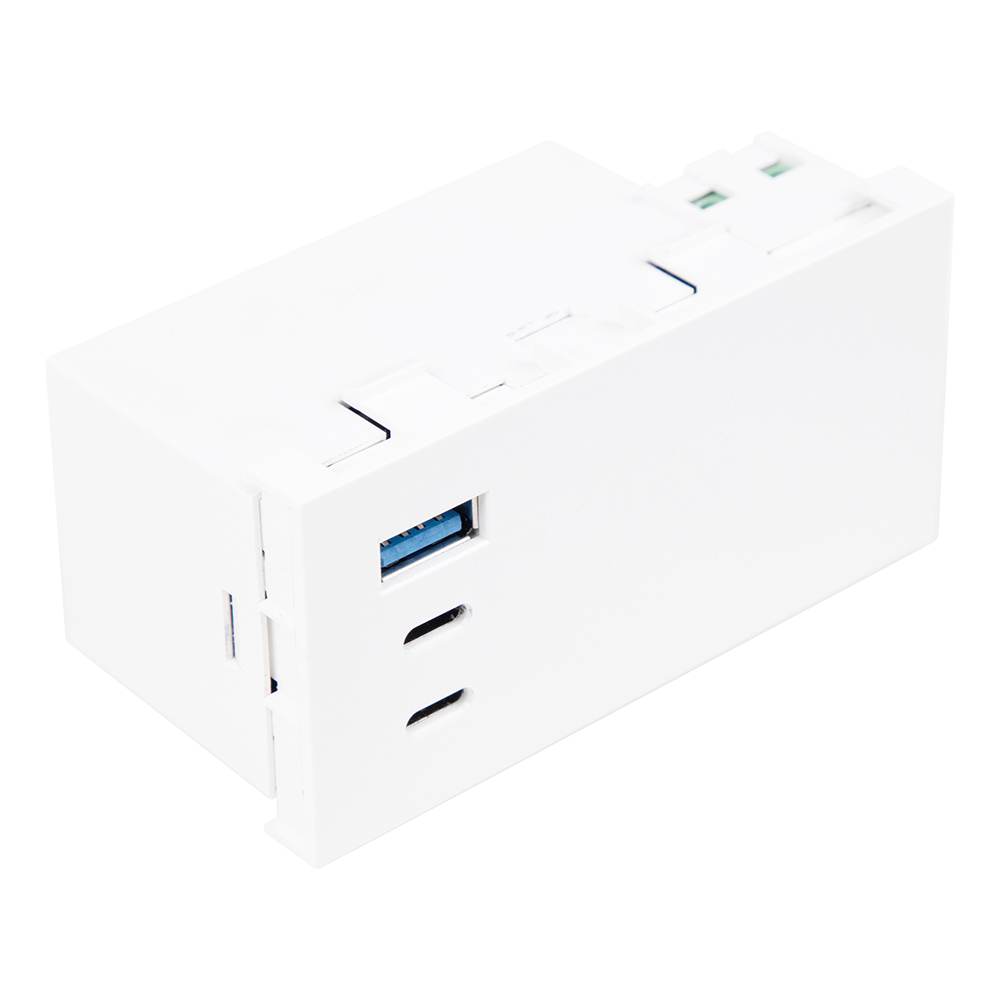
GaN Is Showing Up Everywhere — Including Your DeskGaN technology is not limited to plug-in wall adapters. The same semiconductor efficiency gains that shrank a 65W laptop charger to the size of a large sugar cube are now being integrated directly into office furniture, hotel room desks, and co-working spaces. Pro Tip: Embedded GaN charging modules deliver the same USB-PD fast charging without any cable or adapter visible on the desk. For consumers who spend long hours at a fixed workstation, this represents the logical end-point: no adapter, no cable clutter, just a small flush-mounted port that charges anything. Discover how GLOB-EL integrates this tech: Choosing the Right Fast Charge USB Socket. Frequently Asked QuestionsIs a GaN charger safe for my iPhone or Android phone?Yes. GaN chargers with USB-PD support are fully safe for modern smartphones. The Power Delivery protocol ensures the charger and device negotiate the correct voltage and current before any power flows, preventing overcharging. Can a GaN charger charge my laptop?Yes, provided the charger output matches your laptop's requirement and your laptop charges via USB-C. A 65W GaN charger covers the majority of thin-and-light laptops (MacBooks, Dell XPS); gaming laptops may require 100W+. Are GaN chargers allowed on aeroplanes?Yes. GaN chargers are permitted as carry-on items on commercial flights. The lithium restriction that governs power banks does not apply to GaN chargers, as they contain no internal battery. Is GaN technology the same as wireless charging?No. GaN refers to the semiconductor material used inside a wired charger to improve efficiency. Wireless charging (Qi standard) is a separate inductive charging technology, though some premium stations combine both. Power Your Devices SmarterWhether you are equipping a home office desk or specifying charging modules for a commercial furniture project, GLOB-EL engineers GaN-based USB power solutions built for European safety standards and real-world reliability. Contact GLOB-EL for OEM Specifications |
|