RFQ Checklist · EU Compliance USB Charging Module RFQ for EU-Compliant Furniture OEMsTarget: Furniture OEM Buyers | Focus: Sourcing 30W Modules |
Modern furniture increasingly incorporates integrated charging capabilities to meet workplace and hospitality demands. As illustrated below, the USB charging module represents a critical component in furniture design specifications for EU-compliant products. 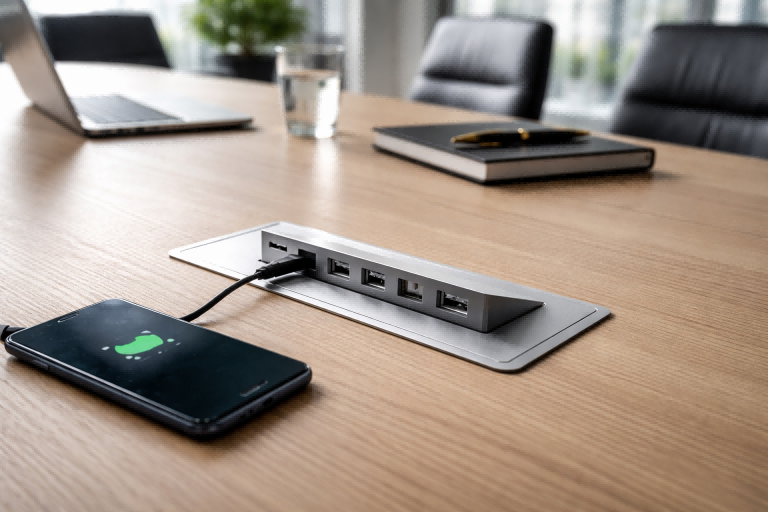 Integrated USB charging module in office workspace furniture enabling seamless device power access |
Leading European furniture manufacturers specify this configuration for conference rooms and collaborative workspaces. This RFQ guide covers the essential technical and compliance requirements for OEM procurement. Core Specs: 30W Output, 100-250V Input, Four PortsOne issue buyers often overlook is how the 30W power specification actually distributes across ports. Most suppliers advertise this number without clarifying whether it is shared across all ports or available per port. When four devices draw power simultaneously, a 30W shared module delivers roughly 7.5W per port. That is enough for a basic feature phone, but insufficient for iPads, flagship Android devices, or anything demanding USB-PD fast charging. In practice, always ask suppliers to provide power test data under full-load conditions. Many datasheets show performance with a single device connected. Enclosed furniture installation removes natural convection cooling. Thermal throttling often surfaces after installation, not during bench testing. A module that performs well with one device may throttle significantly under simultaneous multi-port loads. The 100-250V input range covers most global mains configurations. Confirm whether the module is designed for universal input or requires regional variants. Integration: Surface-Mount vs. Recessed, and Why the Choice Matters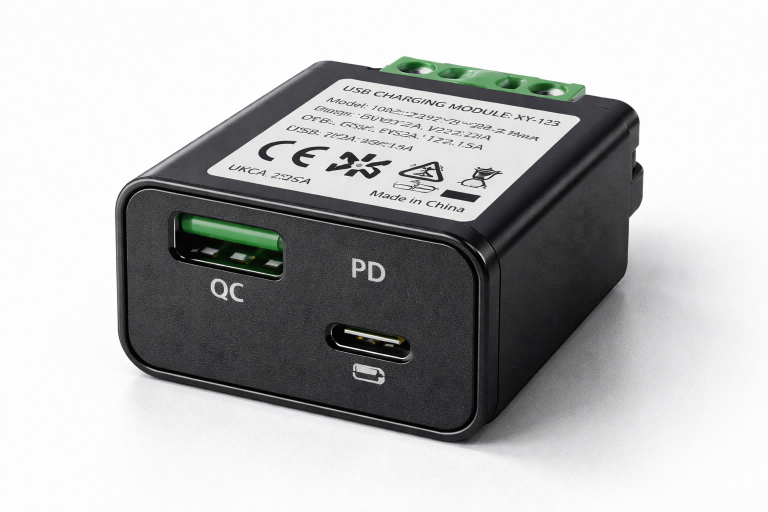 Close-up detail of USB charging module installation demonstrating cable management for furniture OEM |
Surface-mount modules attach to furniture tops. Recessed modules sit inside with only ports and bezels visible. This affects manufacturing cost, aesthetics, and—critically—serviceability. A common sourcing problem is specifying a module without considering how it will be replaced. Ask whether the unit can be accessed from below without removing the furniture. This tends to surface during large-scale deployments. Engineering-led suppliers typically design with service access in mind, since open-plan office fit-outs often require maintaining dozens or hundreds of units. Confirm cut-out dimensions early in the specification process. Standard furniture cut-outs vary by manufacturer and region. A module specified for a 68mm diameter opening will not fit a 72mm cut-out without modification. EU Compliance: What Documentation Actually Protects YouCE marking is mandatory for electrical equipment sold in the EU. For USB charging modules, this means conformity to three directives: LVD (safety), EMC (electromagnetic compatibility), and RoHS (hazardous substance restriction). 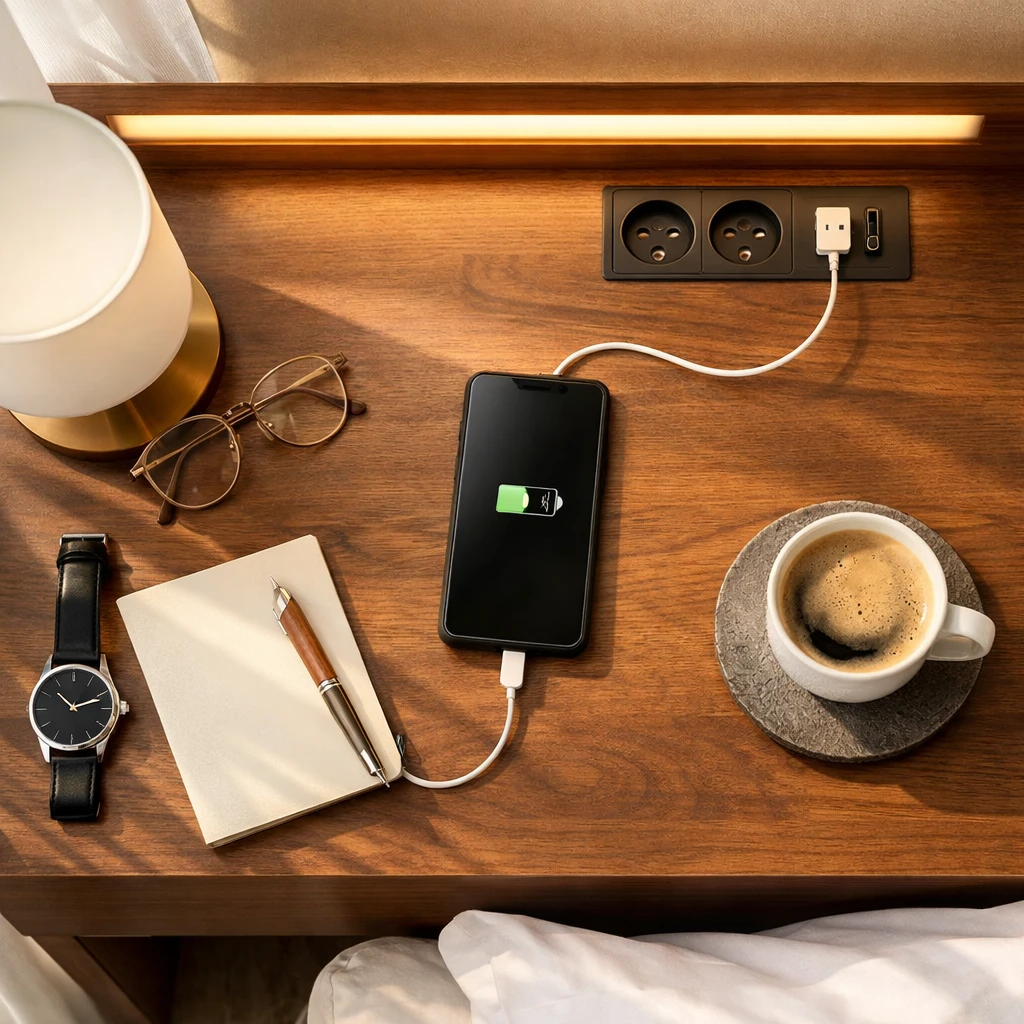 USB charging module showing CE marking and compliance labels for EU market certification |
The technical foundation for LVD compliance is IEC 62368-1:2014. Documentation-backed suppliers will provide the test report, not just the CE declaration. A declaration without supporting test evidence is a red flag. RoHS compliance matters more than many buyers realize. RoHS 3 (EU 2015/863) added four phthalate compounds to the original restriction list. Suppliers still providing documentation referencing only the original 2002 directive have not updated their compliance programs. This often creates issues later during regulatory review or market audits. One compliance reality that frequently surprises buyers: component-level CE certification does not automatically extend to the finished furniture assembly. If your design requires structural modifications—custom bezel, altered enclosure, modified cable harness—you may need additional testing to maintain the compliance chain. Discuss integration changes with your supplier before finalizing the design. For UK-bound products, confirm whether the supplier holds UKCA marking in addition to CE. Northern Ireland products may require both. RFQ Checklist: What to Request and What to RejectIn larger deployment projects, the quality of supplier documentation directly affects project timeline. Experienced suppliers typically respond with complete technical packages within days, not weeks. Request these from every supplier:IEC 62368-1:2014 test report from an accredited laboratory CE Declaration of Conformity (LVD, EMC, RoHS) RoHS 3 (EU 2015/863) conformity declaration with substance data Complete datasheet with dimensions, tolerances, and power specs Thermal test data with measurement conditions clearly stated Sample units for physical verification before bulk order
| Reject the quote if:Supplier cannot provide IEC 62368-1 test documentation RoHS declaration references only the 2002 original, not RoHS 3 Power specs show only single-device performance, not multi-port load data Thermal testing was performed in open-air lab conditions without furniture enclosure simulation
|
Cross-reference test report numbers against the issuing laboratory's public database. Some suppliers use test houses that issue documentation without conducting independent verification. Accredited laboratories maintain searchable records of issued test reports. Red Flags and When to Walk AwayMany OEM teams only discover these issues after prototyping. The most common failure mode in USB module sourcing is not compliance-related. It is communication-related. Suppliers who respond to detailed RFQs with generic marketing materials instead of technical documentation are signaling that they do not have the engineering capability to support furniture OEM requirements. Long-cycle production suppliers usually understand that furniture buyers need consistent documentation across product lifecycle, not just at initial launch. Walk away if:Power specifications are vague or inconsistent across documents Compliance documentation appears templated rather than product-specific Supplier cannot explain why their module is suitable for enclosed furniture installation Lead time exceeds twelve weeks without clear production scheduling
One buyer misconception that surfaces late in projects: many assume that a CE-marked component can be incorporated without further compliance verification. Furniture manufacturers bear responsibility for the compliance of finished products, not just the components. The compliance chain must be maintained through integration, and any design changes may require re-verification. Supply continuity risk deserves attention early. Furniture product lines often run five to ten years. A module selected today must still be available for replacement units throughout that lifecycle. Frequently Asked QuestionsWhat standards must the module meet for EU furniture market compliance?IEC 62368-1:2014 for safety, with CE marking under LVD 2014/35/EU, EMC 2014/30/EU, and RoHS 2011/65/EU (including RoHS 3 amendment EU 2015/863). EN 60884-2-7 applies if the module integrates socket outlets. | How do I interpret power output specifications?Clarify whether the 30W figure represents total shared output or per-port capability. Request multi-device load testing data showing performance with all ports active simultaneously. A module that performs well with one device may throttle significantly under full load. | Does component CE certification cover my finished furniture product?Not automatically. Furniture manufacturers maintain compliance responsibility for the complete assembly. Design modifications, cable changes, or enclosure alterations may require additional testing to maintain the compliance chain. |
About GLOB-ELGLOB-EL has over 35 years of experience supplying USB charging modules and power solutions to European office furniture manufacturers. As a CE/UKCA certified supplier and former IKEA vendor, GLOB-EL specializes in OEM-ODM partnerships with verified compliance documentation and long-term supply relationships. Related Solutions: OEM/ODM ServiceUSB ModulesConference Table Charging |
| 


