


GaN vs Silicon USB socket Modules for Furniture: What Buyers Actually Care About
"GaN" appears on nearly every new charger datasheet. For a furniture OEM or an office fit-out buyer, the marketing message is usually simple: GaN is smaller, cooler, and more modern. But in a usb socket module embedded inside a desk, conference table, or hotel room panel, the decision is not about which chip sounds more advanced. It is about which technology delivers the right size, heat behavior, and total cost for the specific installation.
This guide separates the marketing from the engineering. It explains what gallium nitride (GaN) actually changes inside a USB charger, where traditional silicon still makes sense, and what furniture buyers should actually evaluate before choosing a GaN or silicon usb socket module.
GaN's real advantage is smaller size and lower heat at higher wattages, not faster charging by itself.
For low-wattage phone chargers (around 20 W), a well-designed silicon module is often the better value.
For embedded furniture, the buyer should care about the whole module's measured heat, not the chip brand on the datasheet.
The choice comes down to wattage target, cutout space, and total project cost — not to a technology label.
Certification, thermal design, and long-term availability matter more than whether the chip is GaN or silicon.
What GaN Actually Changes in a USB Charger
Gallium nitride is a wide-bandgap semiconductor material used in the power switches inside a charger. Compared with traditional silicon switches, GaN switches can turn on and off faster and at higher frequencies. Higher switching frequency lets the transformer and other passive components inside the charger be made smaller. The technical background is well documented in materials engineering references such as the gallium nitride article on Wikipedia.
For a furniture buyer, that translates into two practical effects: a GaN-based module can be more compact for a given wattage, and it can run cooler because less energy is lost as heat inside the switch. Both effects are meaningful when the module is squeezed into a small furniture cutout with no airflow.
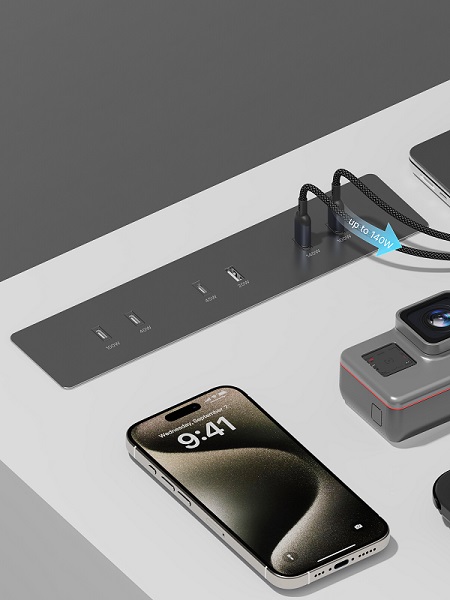
Where Silicon Still Makes Sense
Traditional silicon power switches are mature, well-understood, and cheaper. At low to moderate wattages — a 20 W phone charger, for example — a carefully designed silicon circuit reaches enough efficiency and a small enough footprint that the GaN premium buys little visible benefit. Silicon modules also have a long track record in commercial furniture and a broad supplier base, which matters when a project needs stable lead times.
Buyer-Relevant Differences
| Dimension | GaN-based module | Silicon-based module |
|---|---|---|
| Typical sweet spot | 45 W and above; high-density embedded designs | Up to around 30-45 W; cost-sensitive projects |
| Size for a given wattage | More compact | Slightly larger for the same wattage |
| Heat behavior | Lower internal losses, runs cooler | Higher internal losses, needs thermal design care |
| Unit cost | Premium | More economical |
| Maturity and supply base | Growing, but younger | Mature, broad supplier base |
| Best fit for furniture | Small cutouts, high-wattage laptop charging, luxury or space-tight designs | Standard phone-charging desks, budget projects |
What Buyers Should Actually Evaluate
Whole-Module Efficiency, Not Chip Marketing
A GaN chip does not guarantee a great module. The transformer, the controller, the layout, and the thermal design all determine the real efficiency. A buyer should ask for measured whole-module efficiency and temperature data, not just the chip label.
Measured Heat in an Enclosed Furniture Cavity
This is the single most important furniture-specific test. Ask the supplier for the module's surface temperature under continuous full load, measured the way it will actually sit inside the furniture — enclosed, against wood or laminate, with no forced airflow. A compact module that runs hot in a sealed cavity defeats the purpose of embedding it.
Cutout Size vs. Wattage Target
GaN's size advantage matters only if the cutout is tight. If the furniture design already has room for a larger opening, a silicon module may deliver the same wattage at a lower cost. Match the module size to the planned cutout, not to the technology label.
Total Project Cost
The buyer's cost is not just the unit price. A smaller cutout changes the furniture manufacturing process; a cooler module changes the reliability expectations; a longer supply relationship changes replacement costs. Compare the whole picture over the product's service life.
Thermal Design in Embedded Furniture
Whether the module is GaN or silicon, the way it loses heat decides how long it lasts inside furniture. A standalone charger in open air has natural convection on every side. An embedded module sits inside a wood veneer cavity, with limited airflow and furniture material that traps heat. Every extra degree of internal temperature shortens the expected life of the electrolytic capacitors and the semiconductor junctions. This is why two modules with the same silicon can have very different service lives depending on whether the designer thought about thermal management.
Buyers should ask for the measured surface temperature of the module housing under continuous full load, measured the way it will actually be installed — enclosed, against the furniture material, with no forced airflow. If the supplier can only give an open-air figure, treat that as a rough estimate, not an installation spec. A module that runs at 55 degrees in open air may run 70 degrees inside a sealed cavity, and that gap is where failures happen.
It is also worth asking how the module handles derating when it gets hot. A well-designed usb socket module reduces output gracefully as internal temperature rises, rather than shutting down abruptly or failing. Asking this question reveals whether the supplier has thought about the embedded use case or simply copied a consumer charger design into a furniture housing.
A Simple Decision Guide
| Project situation | Practical choice |
|---|---|
| 20 W phone charging, standard desk | Silicon module — better value |
| 45-65 W laptop charging in a small cutout | GaN module — size and heat advantage |
| 100 W+ high-density embedded design | GaN module — compactness matters |
| Budget-driven, no size constraint | Silicon module |
| Luxury furniture, tight cutout, premium feel | GaN module |
Whichever technology is chosen, the underlying module should still meet the same baseline expectations for commercial furniture: safety aligned with IEC 62368-1, relevant EMC compliance, and — for EU-facing products — alignment with ecodesign requirements such as Regulation (EU) 2019/1782. GaN does not replace certification; it changes the engineering balance inside the box.
What Actually Changes Inside a GaN Charger
To understand why GaN matters, it helps to look inside. In any switching power supply, the main transformer does the heavy lifting of stepping voltage down. The size of that transformer is inversely related to the switching frequency: the faster the switch toggles, the smaller the transformer can be, because energy is transferred in smaller, more frequent packets. Traditional silicon switches lose efficiency at high frequencies, so they are kept at lower frequencies, which keeps the transformer large. GaN switches switch faster with lower loss, which lets the designer raise the frequency and shrink the transformer, the filter capacitors, and the overall footprint.
For a furniture buyer, this means a GaN module at 65 W can occupy roughly the cutout size that a silicon module needs at 30 W. That is a real design freedom: the furniture designer can put more ports in the same opening, or keep the same port count in a smaller opening. It is also why the GaN advantage is most visible at higher wattages — at low wattages, the transformer is already small enough that shrinking it further does not help much.
Reliability Track Record
One concern buyers reasonably raise is whether GaN is "proven" yet. The honest answer is nuanced. GaN power switches have been in mass-produced consumer chargers since the mid-2010s, and the underlying device physics is well understood. The early reliability concerns of GaN — gate instability, gate-drive sensitivity, and packaging failures — have been addressed through mature driver circuits and controlled manufacturing processes. A reputable supplier using a mature GaN platform should be able to provide reliability test data, not just marketing claims.
That said, not every GaN design is equally robust. The reliability of a GaN charger depends as much on the surrounding circuit — the gate driver, the layout, the protection circuitry — as on the GaN switch itself. A cheap, poorly laid-out GaN module can fail earlier than a well-designed silicon module. This is why buyers should evaluate the whole module, not the semiconductor label. Ask for the supplier's qualification test data: temperature cycling, long-duration burn-in, and field failure rates if available.
Common Misconceptions
| Misconception | Reality |
|---|---|
| GaN charges devices faster | Charging speed depends on negotiated wattage and the device; the chip does not by itself overspec the output |
| GaN is always better for furniture | At low wattage, a well-designed silicon module is often the better value |
| Smaller chip means smaller finished module | Finished module size depends on the whole design, not just the switch |
| GaN runs cold by definition | A poor thermal layout can still run hot; ask for measured data |
The technology choice also affects how the buyer should talk to their own customer. A furniture brand selling a premium conference table does not need to explain GaN to the end user; they need to know that the charging point inside the table will be compact, cool, and reliable for years. The engineering choice is internal. The external result is simply that the charging works, quietly, inside furniture that does not look like it contains electronics at all.
Summary
For furniture buyers, the GaN-vs-silicon question is really a wattage-and-cutout question. GaN earns its premium at 45 W and above, where compactness and low heat matter inside an enclosed furniture cavity. Silicon remains the sensible choice for low-wattage, cost-sensitive phone charging. The right way to choose is to ask for measured efficiency, surface temperature under load, and cutout dimensions — and to stop comparing a usb socket module by the semiconductor name on the front page of the datasheet. A supplier who offers both technologies, who can explain which one fits the project, and who backs either choice with thermal test data is the safer long-term partner than a supplier pushing a single technology regardless of fit.
At the end of the selection process, the buyer should be able to say why they chose one technology over the other, in terms of wattage, cutout, and total cost — not in terms of which marketing leaflet impressed them most. That is the difference between a spec that holds up in production and one that looks great in a slide deck.
Specifying a high-wattage or compact furniture charging module?
Glob-el designs and manufactures both silicon and GaN-based USB socket modules for furniture brands and system integrators, from 20 W to 140 W. Every module is tested for embedded use with measured thermal data, and supplied with CE, CB and VDE alignment and UL94 V-0 housings.
Request a Custom QuoteFAQ
Is GaN always better than silicon for furniture USB modules?
No. GaN's advantage is size and heat at higher wattages. For 20 W phone charging, a well-designed silicon module is usually the better value.
Does GaN mean a smaller cutout in the furniture?
Often yes, especially at higher wattages. But finished module size depends on the whole design, so confirm the exact cutout dimensions rather than assuming.
Is a GaN USB socket module more expensive?
Yes, at the module level. Whether the premium is worth it depends on whether the smaller size or lower heat solves a real constraint in the furniture design.
Do I need GaN for a 20 W desk charger?
Usually no. A 20 W charger is within the range where a mature silicon design is efficient, compact, and more economical.
Does GaN run cooler in enclosed furniture?
It tends to have lower internal losses, but the real question is measured surface temperature under full load in an enclosed cavity. Ask the supplier for that test data.
What should I ask a GaN module supplier?
Ask for measured whole-module efficiency, surface temperature under continuous load, exact cutout dimensions, and certification documentation — not just the GaN label on the datasheet.


