


On 24 November 2025 the European Commission published Commission Regulation (EU) 2025/2052, a sweeping update to the ecodesign rules that govern how power supplies are designed, labelled, and sold across the EU. It repeals the previous Regulation (EU) 2019/1782 and becomes fully mandatory on 14 December 2028.
For building engineers, facility managers, furniture system integrators, and procurement teams, the implications are significant — but not always in the way the headlines suggest. The regulation is widely covered as a "universal charger mandate," but a careful reading reveals a set of strategic exemptions that directly affect how embedded and infrastructure-style power solutions are classified.
This article unpacks the regulation in plain language, highlights the exemptions most relevant to commercial and public-space projects, and explains why embedded power modules and USB power modules integrated into trunking systems represent one of the smartest compliance strategies available.
Key Takeaways
EU 2025/2052 requires most AC-DC external power supplies under 100 W to carry a USB Type-C port by 14 December 2028.
A clear exemption exists for power supplies permanently installed inside wall/ceiling structures or locked electrical enclosures — devices not accessible to end users.
Embedded power modules and trunking-integrated USB power modules fall squarely within that exemption.
Engineering teams that adopt embedded modules now gain compliance certainty, cleaner installations, and future-proofed designs.
Glob-el specialises in ODM embedded power modules and trunking socket systems engineered for large office and public-space projects.
The Big Picture: What EU 2025/2052 Actually Requires
The regulation covers a wider product universe than its predecessor. Where the old rules focused mainly on conventional external power supplies (EPS) up to 250 W, the new regulation extends to wireless chargers, wireless charging pads, USB Type-C cables, and portable battery chargers — the full charging ecosystem.
The Core Interoperability Mandate
The regulation's headline requirement — and the one generating the most industry discussion — is the interoperability rule. In short: most AC-DC external power supplies with a rated output of 100 W or less and an output voltage of 48 V or less must now be "interoperable EPS." That means:
| Requirement | What It Means in Practice |
|---|---|
| At least one USB Type-C or USB-PD port required | The charger must accept a standard USB-C cable — no proprietary-only connectors |
| Maximum output power delivered through USB-C/PD port | The highest-power output must be available at the standardised port |
| No hard-wired cable at the USB-C/PD port | The cable must be detachable — built-in cable designs are no longer allowed for these ports |
| Common Charger logo required on product, packaging, and manual | Logo height ≥5 mm on nameplate; ≥7 mm on packaging/manual |
| Port labelling required | Maximum output power must be marked at each USB-C/PD port |
Updated Energy Efficiency Floors
Beyond the interoperability rules, the regulation also tightens energy efficiency requirements. The no-load power consumption limit for single-voltage AC-DC supplies rated at 49 W or less drops from 0.10 W to 0.075 W. A new mandatory minimum efficiency at 10 % load is introduced for supplies above 10 W, and standby power consumption for wireless chargers with integrated power supplies is capped at 0.80 W.
| Parameter | Old Rule (EU 2019/1782) | New Rule (EU 2025/2052) |
|---|---|---|
| No-load power (≤49 W single-voltage AC-DC) | ≤0.10 W | ≤0.075 W |
| 10% low-load efficiency (Pout >49 W) | No requirement | ≥83 % (formula-based) |
| Wireless charger standby (AC input, integrated PSU) | No requirement | ≤0.80 W |
| Wireless charging pad standby (DC input) | No requirement | ≤0.50 W |
| Scope ceiling | ≤250 W output | No upper output limit |
The Exemptions That Change Everything for Commercial Installations
This is where the regulation becomes especially interesting for engineering and infrastructure projects. Article 3 of EU 2025/2052, together with point 3(c) of Annex II, lists the conditions under which an AC-DC power supply is not required to be an interoperable EPS.
Two exemptions stand out for built-environment applications:
In other words: if the power supply is permanently built into the infrastructure — whether inside a cable trunking system, a desk raceway, a ceiling unit, or a locked electrical enclosure — it does not need to carry a USB-C port or the Common Charger logo. The USB power modules and embedded charging units that sit inside these systems are designed for exactly this scenario.
Why This Exemption Exists
The regulation acknowledges a practical reality: a power supply bolted inside a wall-mounted cable trunking system, or wired into the backbone of an office fit-out, is fundamentally different from a plug-in charger a consumer carries in their bag. Forcing USB-C interoperability on infrastructure-grade components would add cost, create safety uncertainties, and offer consumers no practical benefit — because end users cannot swap or replace these components themselves anyway.
What Are Embedded Power Modules and USB Power Modules?
For readers less familiar with infrastructure-grade power solutions, a brief explanation is helpful.
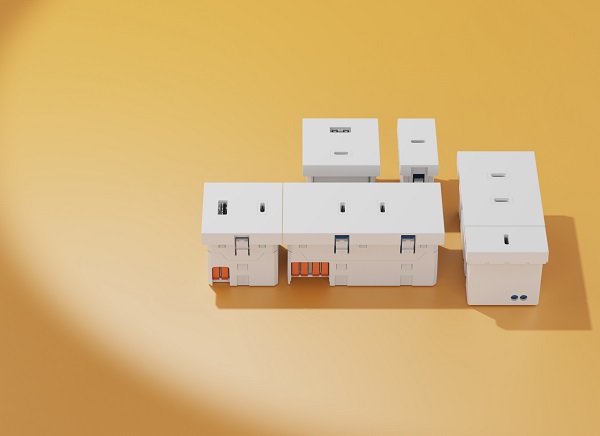
Embedded power modules(sometimes called "embedded charging modules" or "built-in USB power modules") are self-contained power conversion and distribution units designed to be permanently integrated into furniture systems, desk raceways, cable trunking channels, countertops, or wall/ceiling enclosures. They are not designed to be unplugged by users. They receive mains power from a wired connection inside the structure and deliver USB, USB-C, or AC output at the surface-accessible ports the user actually touches.
USB power modules in trunking systems work similarly — a module slots into a dado trunking rail or desktop raceway, connects to the building's mains wiring, and provides fast USB-A and USB-C charging at the point of need. The power conversion happens inside the trunking, invisible to the user.
This architecture is common in large office fit-outs, conference rooms, airport lounges, hotel lobbies, coworking spaces, healthcare waiting areas, and public libraries — anywhere that high-density, reliable, device-agnostic charging is needed without the clutter of individual plug-in adapters.
How the Exemption Applies in a Real Project Scenario
Consider a large office building fit-out with 300 workstations. Each workstation incorporates a trunking-integrated USB power module delivering 30 W USB-A and 30 W USB-C charging, hardwired into the building's electrical infrastructure. These modules are embedded into the dado trunking, accessible only to electricians during installation.
Under EU 2025/2052, this installation scenario qualifies for the electrical-enclosure or permanently-installed-product exemption. The USB power modules are designed, tested, and marketed exclusively for permanent enclosure installation. They do not need to carry a USB-PD port in the regulatory sense, do not require the Common Charger logo, and do not need to meet the interoperable EPS output-port independence rules.
| Scenario | EU 2025/2052 Interoperability Required? | Reason |
|---|---|---|
| Plug-in desktop charger, sold retail | Yes | Standard EPS sold as standalone product |
| USB module in dado trunking (hardwired) | No | Permanently installed, end-user cannot detach |
| Embedded wireless charger in desk surface | No (if non-portable) | Fastened to support, not portable |
| Built-in EPS in locked electrical cabinet | No | In electrical enclosure, no user access |
| Portable charging station with detachable cable | Yes | Portable, consumer-facing,<100 W |
Why Embedded Modules Are a Forward-Looking Design Choice
Even aside from the regulatory exemption, embedded power modules offer several structural advantages for commercial and public-space projects that are becoming more — not less — important as building standards evolve.
Cleaner, More Durable Installations
When power conversion happens inside the trunking or furniture system, there are no loose adapters on desktops, no cable tangles, and no user-replaced components that can introduce uncertified hardware into the installation. The infrastructure ages uniformly, and replacement is handled by facilities teams, not ad-hoc end-user decisions.
High-Density Charging Without Proportional Space Cost
A single trunking channel can integrate multiple USB power modules serving several workstations, sharing a common wiring run. The power-per-metre efficiency of this approach significantly exceeds what is achievable with individual plug-in chargers, especially in space-constrained office designs.
Compliance Certainty Through Design
Because the exemption is tied to the installation context — not to a product certification — engineering teams that specify embedded modules correctly from the start achieve compliance certainty without ongoing certification overhead. The regulatory burden sits with product design and installation documentation, not with annual re-qualification.
Wireless Charging Integration
Qi-certified wireless charging pads designed to be permanently mounted inside desk surfaces or fastened to fixed furniture also benefit from a related exemption under EU 2025/2052: wireless chargers and charging pads that are "fastened to a support or secured in a specific location" are excluded from the requirement that they must themselves be powered by an interoperable EPS. This makes flush-fit wireless desk charging a naturally compliant architecture.
Key Compliance Timeline for Engineering Teams
| Date | Milestone |
|---|---|
| 14 December 2025 | Regulation enters into force; products already meeting new rules are automatically compliant with old rules |
| 14 December 2028 | Full mandatory application — all EPS on EU market must comply with EU 2025/2052 |
| 14 December 2030 | Deadline for USB-PD EPS >100 W to transition from old efficiency standard |
| 14 December 2033 | Spare-part EPS exemption expires — even replacement units must meet new rules by this date |
For project teams specifying infrastructure for buildings expected to be in service well beyond 2028, designing with embedded and trunking-integrated modules now eliminates a compliance retrofit risk entirely.
What to Look for When Specifying Embedded Power Modules
Not all embedded charging modules are equal. When evaluating products for large-scale commercial or public-space deployment, engineering and procurement teams should consider the following criteria:
Certifications and Safety Ratings
Modules should carry relevant EU safety certifications (CE marking) and ideally Qi certification for wireless charging components. Products specified for office use should meet IEC 62368-1 or equivalent applicable safety standards. Given that EU 2025/2052 introduces a new 2.5 kV surge resistibility test for interoperable EPS, infrastructure-grade modules should demonstrate comparable surge protection even where the formal test does not apply.
Output Power and Protocol Support
Modern office environments host a wide mix of devices. USB power modules should support at least USB Power Delivery (USB-PD) at the output ports users interact with, even if the embedded power supply itself is exempt from the interoperability requirements. Modules offering up to 65 W or 100 W USB-C output per port cover the vast majority of laptops, tablets, and smartphones in professional use.
Form Factor and Trunking Compatibility
Embedded modules need to fit the mechanical standard of the trunking or furniture system in use. The most common sizes in European commercial fit-outs are 45 mm × 45 mm (DIN 49073) and formats compatible with 45–80 mm dado trunking channels. Modules that integrate quick-connect terminals cut installation time significantly on large-scale projects.
Thermal Management and Rated Lifetime
Unlike a plug-in charger that a user removes when not in use, an embedded module may run continuously for years. Thermal design, component derating, and rated operational lifetime are therefore critical procurement criteria — not afterthoughts.
Looking for a Compliant Embedded Power Module Partner?
Glob-el specialises in ODM embedded power modules and trunking socket systems for large office, hospitality, and public-space projects. From Qi2-certified wireless charging pads to high-density USB power modules for dado trunking, the team can help engineering and procurement teams specify, sample, and certify the right solution for any project scale.
Request a Free Project Consultation →Glob-el: Infrastructure Charging Built for the Long Term
Glob-el designs and manufactures embedded power modules and trunking socket systems as an ODM partner to furniture brands, systems integrators, and electrical wholesalers. The product range covers:
USB power modules — from 18 W single-port to 140 W multi-port configurations, supporting USB-PD 3.1 fast charging, designed for flush integration into cable trunking and furniture raceways. View USB Charging Modules →
Wireless charging modules — Qi2-certified embedded pads with up to 30 W fast wireless output, engineered to work through non-metallic desk surfaces without interference issues. View Wireless Charging Modules →
Trunking socket systems — dado trunking sockets compatible with 45–80 mm channel systems, featuring quick-connect terminals, integrated USB ports, and a modular architecture that lets specifiers combine AC, USB-A, and USB-C outputs in a single channel run. View Trunking Socket Systems →
All products are developed under an ODM model — meaning engineering teams can specify custom branding, port configurations, and mechanical formats without taking on in-house electronics development. Glob-el manages the certification process and handles production scaling from prototypes to six-figure unit runs.
In Summary
EU 2025/2052 is a landmark regulation that will change the design of consumer chargers across Europe. But its interoperability mandate was never intended to apply to power infrastructure permanently embedded into buildings. The regulation's own text carves out a clear, defensible exemption for exactly this scenario. Engineering teams that understand this distinction — and specify embedded power modules accordingly — gain compliance certainty, cleaner installations, and infrastructure that will not need a costly regulatory retrofit in 2028.


