


EU EMC Directive 2014/30/EU: Furniture OEM Compliance Guide 2026
Compliance Guide · OEM Procurement
EU EMC Directive 2014/30/EU for Furniture OEMs: Compliance Guide for Embedded USB Charging Modules (2026)
Navigating electromagnetic compatibility requirements for European B2B furniture integration.
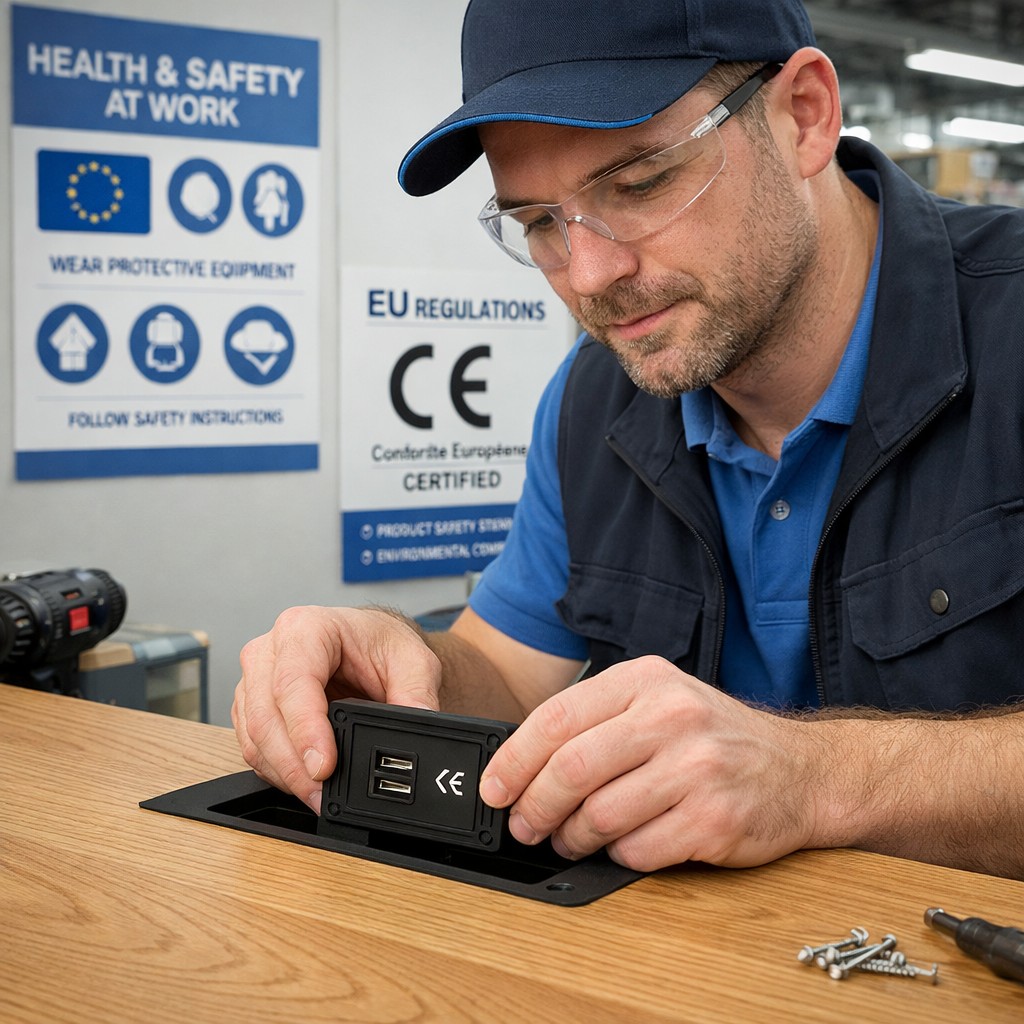
Core Technology: EU EMC Directive 2014/30/EU mandates electromagnetic compatibility compliance for embedded USB charging modules in furniture, requiring adherence to EN 55032 (emissions) and EN 55035 (immunity) harmonized standards.
OEM Advantage: GLOB-EL's pre-certified USB power modules for furniture integration reduce EMC retesting risk by providing full EN 55032 Class B and EN 55035 test reports, installation guidance, and DoC documentation support.
EU Compliance: CE marking for furniture with embedded USB charging requires separate technical files for LVD (IEC 62368-1) and EMC (2014/30/EU) directives, with GLOB-EL providing dual-directive compliance evidence.
Every furniture OEM embedding a USB charging module into a desk, workstation panel, or hospitality bedside unit must demonstrate conformity with the EU EMC Directive 2014/30/EU before affixing the CE mark. Yet electromagnetic compatibility (EMC) compliance is routinely underestimated — procurement teams focus on safety certifications under IEC 62368-1, while EMC testing obligations under EN 55032 and EN 55035 are addressed only at the last stage, delaying market entry by weeks and adding unbudgeted retesting costs.
This guide provides a structured roadmap for European furniture OEM buyers, product engineers, and compliance managers. It covers the legislative scope of Directive 2014/30/EU as it applies to embedded AC-powered USB charging modules, the mandatory harmonised standards (EN 55032 for emissions, EN 55035 for immunity), the Declaration of Conformity pathway, and what to demand from your module supplier before signing a sourcing agreement.
1. What EMC Directive 2014/30/EU Requires of Furniture OEMs
Published in the Official Journal of the European Union on 29 March 2014 (OJ L 96), Directive 2014/30/EU recast and replaced the previous EMC Directive 2004/108/EC. It applies to all electrical and electronic apparatus placed on the EU market that can generate electromagnetic disturbance or whose performance can be affected by such disturbance. USB charging modules embedded in furniture — whether desk-integrated power modules, cabinet-mounted multi-port USB-C hubs, or hospitality bedside charging stations — fall squarely within this scope.
The Directive imposes two categories of essential requirements on manufacturers and OEMs who assemble final products:
The apparatus shall not generate electromagnetic disturbance exceeding levels that would prevent radio and telecommunications equipment, or other apparatus, from functioning as intended.
The apparatus shall have a level of intrinsic immunity to electromagnetic disturbance that allows it to operate as intended when deployed in its intended electromagnetic environment.
For furniture OEMs, the critical compliance question is whether the embedded USB module is treated as a component or as a finished apparatus. Article 2(2)(b) of the Directive provides a partial exemption for apparatus intended for incorporation into defined installations — but only when the module is not intended to be made available to end users independently. In practice, any furniture piece sold to hospitality clients or office end users as a finished product containing an active electrical module must be assessed as a finished apparatus, with the OEM holding the technical documentation and signing the Declaration of Conformity.
2. Harmonised Standards: EN 55032 and EN 55035
Compliance with the essential requirements of Directive 2014/30/EU is presumed when the relevant harmonised standards are applied. For USB charging modules and multimedia-class power electronics, the applicable pair is:
| Standard | Scope | Replaces | CE Presumption |
|---|---|---|---|
| EN 55032:2015+A11:2020 (CISPR 32) | Electromagnetic emissions from multimedia equipment | EN 55022 (IT equipment emissions) | Partial — emissions only |
| EN 55035:2017+A11:2020 (CISPR 35) | Immunity requirements for multimedia equipment | EN 55024 (IT equipment immunity) | Completes full EMC conformity |
EN 55032 defines conducted and radiated emission limits across two classes: Class A for industrial environments, and Class B for residential and commercial use — the class relevant for office furniture and hospitality applications. Limits apply from 150 kHz to 1 GHz (conducted) and 30 MHz to 6 GHz (radiated), with Class B limits typically 10 dB more stringent than Class A. GLOB-EL's methodology includes designing GaN USB modules with integrated multi-stage filtering to maintain a minimum 6 dB margin to Class B limits.
EN 55035 covers immunity to electrostatic discharge (ESD), radiated RF fields, electrical fast transients, surge, conducted RF, and power frequency magnetic fields. A USB charging module that fails immunity testing may exhibit intermittent charging failures, output voltage collapse, or complete reset under ESD events — unacceptable in a B2B furniture environment. GLOB-EL addresses this with PCB layout optimizations and protection circuitry specifically tested to EN 55035 Level 2 requirements.
Critical Requirement: Using both EN 55032 and EN 55035 together provides a complete EMC assessment, giving presumption of conformity with the full scope of Directive 2014/30/EU. Compliance with EN 55032 alone is insufficient.
2.1 EMC Test Parameters for Class B USB Charging Modules
| Test Parameter | Standard | Class B Limit / Level | Relevance for USB Modules |
|---|---|---|---|
| Conducted Emissions (Mains port) | EN 55032, CISPR 16 | 66-56 dBuV (QP) 0.15-0.5 MHz | Switching noise from AC-DC converter injected onto mains. |
| Radiated Emissions | EN 55032 | 30 dBuV/m at 30 MHz (measured at 10m) | Harmonic radiation from switching frequency and USB data lines. |
| ESD Immunity | IEC 61000-4-2 (EN 55035) | Level 2: 4 kV contact 8 kV air | Human-body electrostatic discharge to USB port or panel surface. |
| Fast Transient | IEC 61000-4-4 (EN 55035) | Level 2: 1 kV on mains port | Inductive switching transients from co-located equipment. |
| Surge Immunity | IEC 61000-4-5 (EN 55035) | Level 2: 1 kV L-E 0.5 kV L-N | Lightning-induced surges on building AC infrastructure. |
| Conducted RF | IEC 61000-4-6 (EN 55035) | Level 2: 3 V rms (0.15-80 MHz) | RF interference from nearby wireless devices or industrial equipment. |
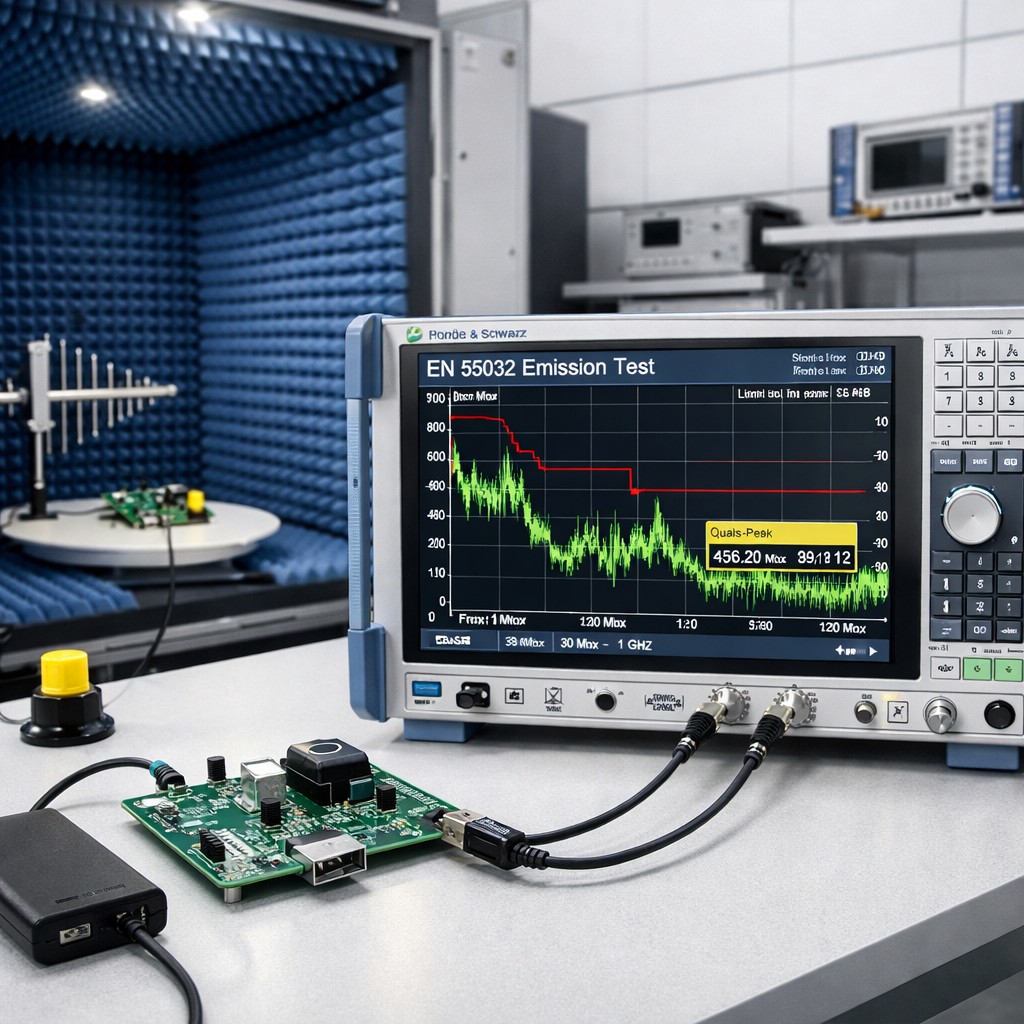
Table 1: Key EMC test parameters for Class B USB charging modules.
3. The OEM's Dual-Role Responsibility
Furniture OEMs occupy a dual position in the EMC compliance chain. As buyers of USB charging modules, they rely on supplier-provided test reports. As manufacturers of the finished furniture apparatus, they are legally responsible for the EMC performance of the complete assembly under Article 7 of Directive 2014/30/EU.
This distinction has practical consequences. A USB module may pass EN 55032 Class B as a standalone unit in the test laboratory, but when installed in a metal furniture panel with 300 mm of interconnecting cable running adjacent to data lines, the radiated emissions profile changes. The resonant coupling between the module's switching frequency harmonics and the panel geometry can shift emission peaks by 6-12 dB — sufficient to breach the Class B limit and invalidate the supplier's test report as a compliance basis for the final product.
Obtain the module supplier's EN 55032 + EN 55035 test report and verify that the test configuration (cable length, panel cutout, grounding) matches the intended furniture installation.
Conduct an in-situ EMC pre-scan of a representative furniture prototype before final design freeze, using a screened room or semi-anechoic chamber at a notified body or accredited test facility.
Document any installation conditions (maximum cable run length, bonding requirements, ferrite bead positions) in the furniture assembly instructions, as these become part of the technical file.
"Compliance with EN 55032 alone is not sufficient to demonstrate conformity with Directive 2014/30/EU. Manufacturers must apply both EN 55032 (emissions) and EN 55035 (immunity) to achieve full presumption of conformity." — EMC Technical Reference
4. EMC Directive vs. Low Voltage Directive: Avoiding the Trap
Furniture OEMs frequently conflate EMC compliance (Directive 2014/30/EU) with Low Voltage Directive compliance (LVD, Directive 2014/35/EU). Both directives apply to AC-powered USB charging modules operating within LVD voltage limits, and both require a CE mark — but they are assessed under entirely separate harmonised standards and technical file requirements.
| Dimension | EMC Directive 2014/30/EU | LVD 2014/35/EU |
|---|---|---|
| Core Concern | Electromagnetic emissions & immunity | Electrical safety (shock, fire, thermal) |
| Key Standard | EN 55032 + EN 55035 | EN IEC 62368-1:2020 |
| Notified Body? | No — self-declaration permitted | No — but 3rd-party testing recommended |
| Tech File Content | EMC risk assessment, test reports, install conditions | Safety risk assessment, test reports, BOM, drawings |
| DoC Reference | Must explicitly cite 2014/30/EU and EN 55032/35 | Must explicitly cite 2014/35/EU and IEC 62368-1 |
A USB charging module CE-marked under LVD alone does not satisfy the EMC Directive. Both declarations must appear in the EU Declaration of Conformity, and the technical file must contain supporting evidence for both directives. Market surveillance authorities in Germany (BNetzA) and the Netherlands (RDI) specifically check for the completeness of dual-directive technical files.
5. What to Demand from Your USB Module Supplier: EMC Checklist
Sourcing decisions made at the component level determine whether the OEM faces a straightforward market entry or a costly late-stage retesting cycle. Apply this checklist to any USB charging module under evaluation for EU furniture integration:
Acceptable: Full test report from ISO/IEC 17025 accredited lab, dated within 3 years.
Red Flag: Class A report only; FCC Part 15 report submitted in lieu of EN 55032.
Acceptable: Full test report covering IEC 61000-4-2/3/4/5/6 sub-tests.
Red Flag: EN 55024 report (superseded standard); no immunity report provided.
Acceptable: Test setup photos, cable length during test clearly stated, auxiliary equipment used.
Red Flag: Test report lacks setup details; module tested with 0.1 m cable but furniture uses 0.5 m.
Acceptable: Signed DoC explicitly citing Directive 2014/30/EU, EN 55032, and EN 55035.
Red Flag: DoC only cites LVD; no EMC directive reference.
6. GaN Technology and EMC: Opportunity and Challenge
Gallium nitride (GaN) switching technology is rapidly replacing silicon MOSFETs in high-density USB charging modules for furniture applications, enabling 65W or 100W GaN modules at form factors that fit standard 45 mm or 50 mm panel cutouts. However, GaN's faster switching transitions significantly increase high-frequency harmonic content, placing greater demands on EMC filter design.
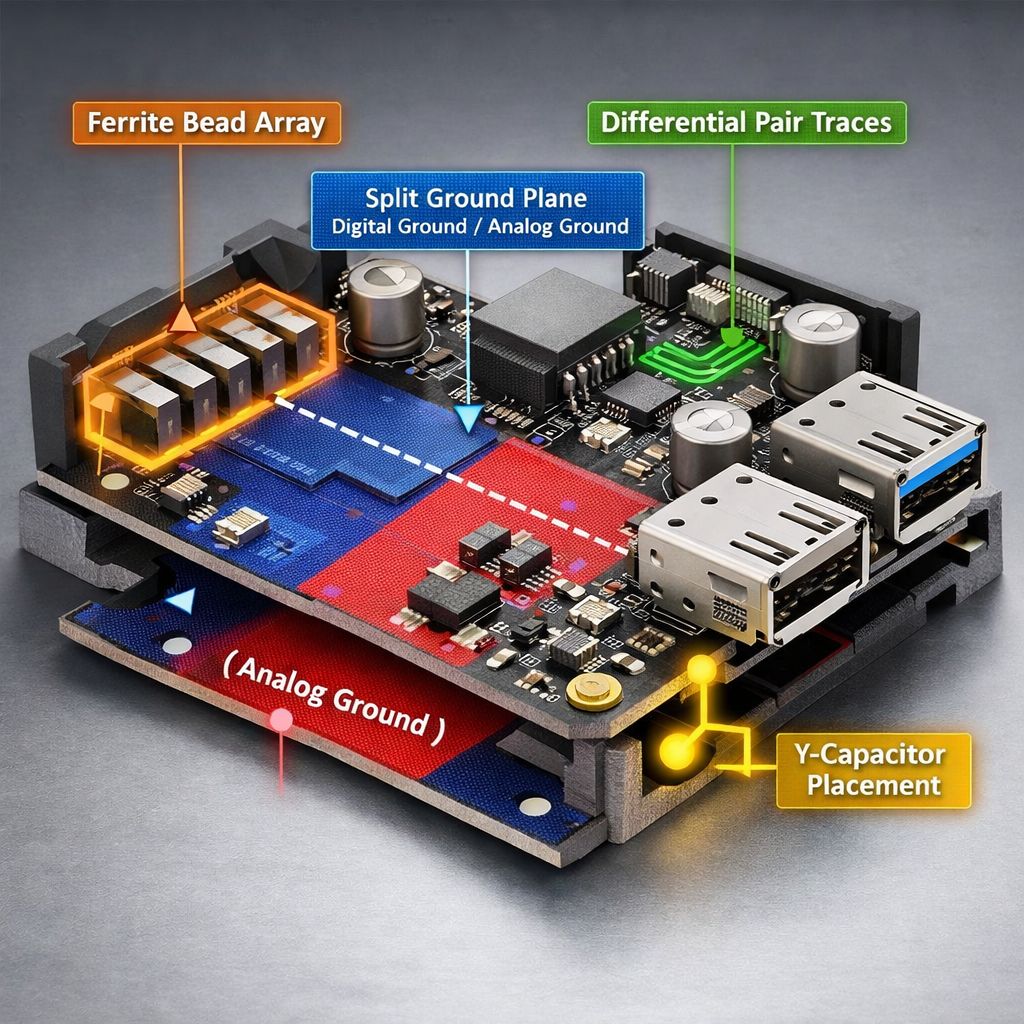
GLOB-EL's engineering approach addresses this challenge through optimized PCB layout, carefully controlled switching loop areas, and integrated multi-stage filtering specifically designed for GaN characteristics while maintaining full EN 55032 Class B compliance. Key EMC design elements in a well-engineered GLOB-EL GaN module include:
Two-stage common-mode choke on the AC input line, with low-leakage-current design to comply with IEC 62368-1 touch current limits simultaneously.
X2 and Y2 capacitors sized to suppress differential and common-mode noise above 150 kHz without exceeding the leakage current budget.
Output-side ferrite bead network on VBUS and GND lines to suppress USB-port conducted emissions.
PCB layout optimisation: minimised switching loop area, return current path control beneath the GaN half-bridge, and shielding of the magnetics.
7. Frequently Asked Questions
Not always, but it depends on the installation configuration. If the module's test report conditions closely match your furniture assembly (same cable lengths, panel construction), you may rely on it as primary evidence. If conditions differ significantly, a representative pre-compliance scan of the final furniture product is strongly recommended.
No. Article 14 of Directive 2014/30/EU allows manufacturers to self-declare conformity based on their own technical assessment supported by EN 55032 and EN 55035 test data from an accredited laboratory.
Class B limits are approx 10 dB more stringent than Class A, intended for residential and commercial environments (offices, hotels). Class A is for industrial use only. For furniture intended for office or residential use, Class B certification is the only acceptable classification.
No. FCC Part 15 and EN 55032 are separate frameworks. An FCC report does not provide presumption of conformity with EU Directive 2014/30/EU. You must have data specifically comparing measurements against EN 55032 limits.
Sourcing EMC-Compliant USB Modules for EU Furniture
GLOB-EL supplies European furniture OEMs and hospitality fit-out contractors with embedded USB charging modules certified to EN 55032 Class B and EN 55035, complete with technical file documentation packages, test reports, and module-level DoCs.


