


Key Takeaways
IEC 62368-1 compliance is mandatory for commercial 100W USB-C installations, ensuring protection against electrical shock, fire, and thermal hazards.
Thermal management distinguishes safe products — double-width 90x45mm modules provide superior heat dissipation compared to compact single-width designs.
Installation quality matters as much as product quality — proper grounding, adequate ventilation, and certified wiring are critical safety factors.
USB socket modules with dual ports reduce fire risk by distributing power load and preventing single-point thermal concentration.
Hotels and offices share similar safety requirements but differ in usage patterns, maintenance access, and liability considerations.
Understanding 100W USB-C Power Delivery Technology
The USB Power Delivery specification enables USB-C ports to deliver up to 100 watts through dynamic voltage negotiation between the charger and device. Unlike traditional USB charging that operates at a fixed 5 volts, a 100W USB-C charging module can adjust voltage from 5V to 20V while varying current output accordingly.
This intelligent power management creates specific safety considerations. The charging module must continuously monitor connected devices, adjust power levels in real-time, and implement protective shutdowns if abnormal conditions occur. According to safety standards documentation, devices operating above 60V DC or delivering more than 240VA are classified as higher-risk energy sources requiring enhanced safeguards.
Technical Note:
A 100W USB-C charging module typically delivers power at 20V/5A, which falls within the ES2 (moderate risk) category under international electrical safety classifications. This designation requires specific insulation, grounding, and thermal protections.
Critical Safety Standards for Commercial Installation
IEC 62368-1: The Foundation of Electrical Safety
Modern USB socket modules must comply with IEC 62368-1, the international standard for audio, video, information, and communication technology equipment. This hazard-based standard replaced older prescriptive standards and takes a risk-oriented approach to safety engineering.
The standard identifies potential energy sources and requires manufacturers to implement appropriate safeguards based on risk levels. For 100W charging modules, this includes protection against electric shock, fire ignition, excessive temperatures, and mechanical hazards. Independent testing laboratories verify compliance through rigorous protocols before products can receive certification marks.
Workplace electrical safety regulations emphasize that equipment must be "free from recognized hazards that are likely to cause death or serious physical harm." The OSHA 1910.303 standard requires that all electrical equipment be approved for its intended use and properly installed according to established codes.
Regional Certification Requirements
| Region | Required Certification | Key Standards |
|---|---|---|
| European Union | CE Marking | IEC 62368-1, EN 61558, RoHS, REACH |
| North America | UL/ETL Listed | UL 62368-1, NEC Compliance |
| United Kingdom | UKCA Marking | BS EN 62368-1 |
| Asia-Pacific | PSE, CCC, RCM | Regional variations of IEC 62368-1 |
Thermal Management: The Critical Safety Factor
Heat generation represents the primary safety concern in high-power charging applications. A 100W USB-C charging module operating at full capacity generates significant thermal energy that must be effectively dissipated to prevent component degradation, housing damage, or fire risk.
Professional-grade modules employ multiple thermal management strategies. Circuit board layout separates high-heat components, heat-dissipating materials transfer thermal energy away from sensitive areas, and chassis design maximizes surface area for passive cooling. The physical format of the module significantly impacts thermal performance.
Module Format and Heat Dissipation
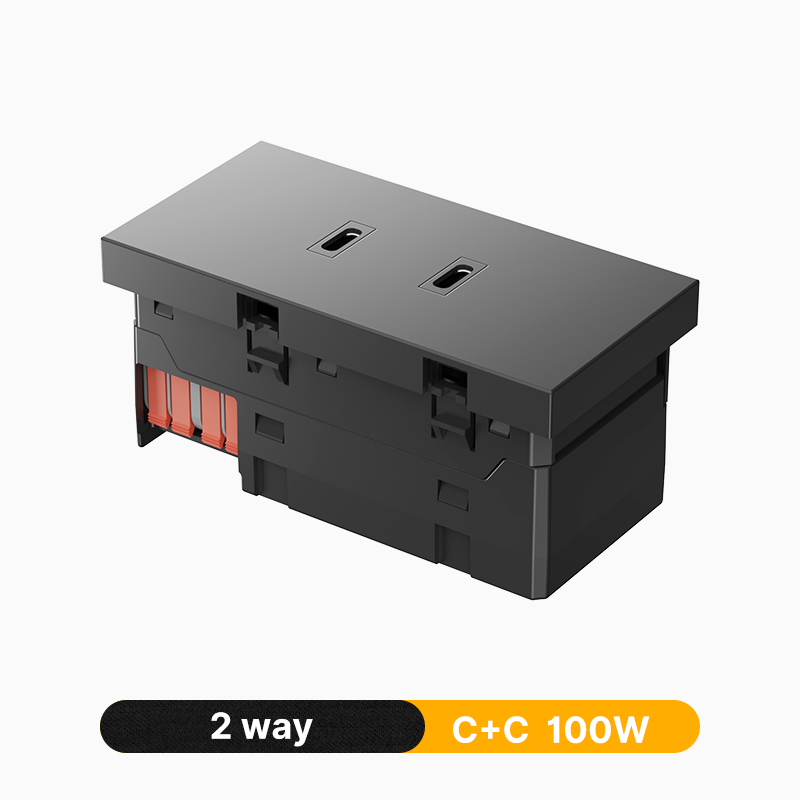
Double-width 90x45mm USB socket modules provide approximately twice the internal volume and surface area compared to standard 45x45mm single-width designs. This additional space allows for optimized component spacing, larger heat-dissipating elements, and improved air circulation within the enclosure.
Testing data shows that properly designed 2-way format modules operating at 100W maintain junction temperatures 15-20°C lower than compact alternatives under identical load conditions. This temperature differential directly impacts long-term reliability and fire safety margins.
Safety Insight:
Commercial installations should prioritize modules with thermal ratings that provide at least 20% margin above maximum expected power draw. This ensures safe operation even in warm environments or enclosed furniture applications.
Office Environment Safety Considerations
Office installations present unique safety requirements based on usage patterns and regulatory compliance. Employees typically use charging infrastructure for 8-12 hours daily, creating sustained thermal loads. Conference rooms may have multiple users simultaneously connecting high-power laptops, demanding reliable current delivery without voltage sag or thermal issues.
Workplace Electrical Safety Requirements
Commercial workplaces must comply with occupational safety regulations that govern electrical installations. Standards require that equipment be properly grounded, circuit protection devices be correctly sized, and installations performed by qualified personnel following national electrical codes.
The integration of charging modules into desking systems or conference tables requires careful attention to ventilation. Enclosed furniture can trap heat, potentially elevating operating temperatures beyond safe limits. Professional installations incorporate ventilation pathways and avoid placing multiple high-power devices in confined spaces without adequate air circulation.
User Behavior and Safety
Unlike residential settings where users typically understand their own equipment, office environments involve diverse device types and user technical knowledge levels. A well-designed 100W USB-C charging module automatically negotiates appropriate power levels with each connected device, preventing overcharging or incompatible power delivery.
Modern USB socket modules incorporate smart power allocation that dynamically distributes available wattage between multiple ports. When both ports are in use, the system ensures neither device receives excessive current while maintaining optimal charging speeds within safe parameters.
Hospitality Industry Safety Requirements
Hotels face additional safety considerations beyond those found in office environments. Guest rooms experience constant turnover with users who have no familiarity with the property's electrical infrastructure. Charging devices remain connected during sleep hours, increasing the importance of fail-safe protection systems.
Liability and Guest Safety
Hospitality operators carry significant liability for guest safety, making proper specification and installation of charging infrastructure essential. Fire incidents traced to electrical equipment can result in property damage, injury, and substantial legal exposure. This drives hotels toward certified products with established safety records rather than economy-focused alternatives.
Professional hotel brands increasingly specify USB charging solutions with UL or ETL certification for North American properties and appropriate regional certifications for international locations. These third-party verified products have undergone extensive testing including thermal stress, abnormal operation scenarios, and dielectric strength validation.
Maintenance and Durability
Hotel charging infrastructure experiences significantly higher insertion cycles than typical office installations. Housekeeping staff may unplug devices daily, and guests connect and disconnect equipment multiple times throughout their stay. Quality USB socket modules feature reinforced connectors rated for 10,000+ insertion cycles and robust housing materials that withstand repeated physical contact.
Maintenance accessibility varies dramatically between office and hotel installations. Desk-mounted modules in offices can be serviced during business hours with minimal disruption. Guest room installations require service during vacancy periods, making reliability and long service life critical selection factors.
Critical Warning:
Never install charging modules without adequate ventilation or in direct contact with thermally insulating materials. Enclosed installations require specific thermal analysis to ensure safe operating temperatures under continuous full-load conditions.
Installation Best Practices for Maximum Safety
Even the most robustly designed 100W USB-C charging module can become a safety hazard if improperly installed. Professional installation following manufacturer specifications and local electrical codes represents the foundation of safe operation.
Electrical Installation Requirements
USB socket modules require connection to properly rated circuits with appropriate overcurrent protection. Most 100W modules specify 2.5mm² wire capacity at terminals and should be connected to 15-20 ampere circuits depending on total load calculations. Multiple modules on a shared circuit require load assessment to prevent circuit breaker nuisance tripping.
Grounding integrity is essential for safety. All modules must connect to properly grounded circuits, and installation should verify ground continuity before energizing equipment. Loose or corroded ground connections compromise both equipment protection and user safety in fault conditions.
Environmental Factors
| Environmental Factor | Impact on Safety | Mitigation Strategy |
|---|---|---|
| Ambient Temperature | Reduces thermal headroom; increases component stress | Ensure HVAC maintains 25°C or lower in equipment areas |
| Humidity | Can cause condensation and corrosion in connections | Use IP20-rated modules; maintain 30-70% relative humidity |
| Dust Accumulation | Insulates heat-generating components; reduces cooling | Regular cleaning schedule; avoid installations in dusty areas |
| Ventilation Obstruction | Prevents heat dissipation; raises operating temperature | Maintain minimum 40mm installation depth; avoid enclosed boxes |
Comparing Safety Features Across Product Categories
Not all 100W USB-C modules offer equivalent safety performance. Key differentiators include circuit topology, component quality, thermal design, and compliance verification. Understanding these differences helps facility managers select products appropriate for their specific risk profiles.
Essential Safety Features
Professional-grade USB socket modules incorporate multiple layers of protection. Overcurrent protection prevents damage if a device attempts to draw excessive current. Overvoltage protection shields connected equipment from power surges or regulation failures. Thermal monitoring automatically reduces power output or shuts down if internal temperatures exceed safe thresholds.
Short circuit protection represents perhaps the most critical safety feature. Quality modules detect and respond to short circuit conditions within microseconds, preventing fire ignition or component explosions. This rapid response requires sophisticated control circuitry and represents a key differentiator between commercial-grade and consumer-oriented products.
Material Selection and Fire Safety
Housing materials directly impact fire safety. Commercial charging modules should utilize materials with UL94 V-0 flame rating, the highest classification for plastic components. This rating indicates the material self-extinguishes within seconds of ignition source removal and does not produce flaming drips that could spread fire.
Internal component selection also affects safety margins. Quality modules use high-temperature-rated capacitors, properly sized MOSFETs with adequate thermal mass, and voltage regulation components with appropriate power handling capabilities. Economy products may meet minimum specifications while operating components closer to their maximum ratings, reducing safety margins under abnormal conditions.
Ready to Upgrade Your Charging Infrastructure?
Professional facilities require certified charging solutions that deliver reliable performance and meet stringent safety standards. Glob-el specializes in commercial-grade power modules engineered for demanding office and hospitality environments.
The company's 100W dual USB-C modules feature double-width thermal management, full IEC 62368-1 compliance, and robust construction designed for years of reliable service. Each module undergoes extensive testing to ensure it meets the highest safety standards for commercial installation.
Long-Term Reliability and Safety Performance
Initial safety certification represents only the starting point for commercial charging infrastructure. Long-term performance depends on component quality, thermal design margins, and environmental conditions throughout the product's operational life.
Component Degradation Over Time
Electronic components experience gradual performance changes over thousands of operating hours. Electrolytic capacitors lose capacitance, affecting power supply regulation. Contact resistance in connectors increases from insertion cycles and environmental exposure. These changes remain within safe parameters in quality products but can compromise marginal designs.
Commercial installations should anticipate 5-7 years of service life from properly specified modules. This duration assumes normal office or hotel conditions with ambient temperatures below 25°C and moderate duty cycles. Continuous full-load operation or elevated ambient temperatures accelerate component aging and may reduce service life.
Maintenance and Inspection Protocols
While USB socket modules require minimal active maintenance, periodic inspection helps identify developing issues before they create safety hazards. Visual inspection should look for discoloration around terminals indicating overheating, physical damage to housings or connectors, and signs of moisture intrusion or contamination.
Thermal imaging can detect abnormal heat patterns suggesting internal component stress or poor connections. Annual thermal surveys of high-density charging installations help facility managers identify units requiring replacement before failures occur. This proactive approach minimizes downtime and eliminates safety risks from degraded equipment.
Future Safety Considerations: Beyond 100W
The USB Power Delivery specification continues evolving, with Extended Power Range enabling up to 240W delivery over USB-C connections. This advancement creates new opportunities for powering high-performance workstations but introduces additional safety challenges requiring enhanced protective measures.
According to recent standards development, devices supporting power levels consistently exceeding 100W require additional functional safety evaluations and must implement protocol-based safeguards. The emerging IEC 63315 standard will establish specific requirements for high-power USB applications, replacing portions of current safety standards.
Facilities planning charging infrastructure upgrades should consider future power requirements. Installing modules with headroom above current needs provides flexibility as device power demands increase. However, this approach requires careful attention to thermal management since higher-power capability creates greater heat generation under full load.
Summary: Making Safe Charging Decisions
A 100W USB-C charging module can absolutely provide safe, reliable service in office and hospitality environments when properly specified, installed, and maintained. The key factors determining safety include comprehensive electrical safety certification, robust thermal management design, quality component selection, and professional installation following manufacturer specifications.
Facility managers should prioritize products with IEC 62368-1 certification, adequate thermal headroom through proper sizing, and established track records in commercial applications. The modest cost difference between economy and professional-grade modules becomes insignificant compared to the potential consequences of electrical incidents.
Organizations seeking reliable charging infrastructure can benefit from working with established manufacturers who understand commercial safety requirements. Glob-el's experience in OEM power module manufacturing ensures products meet both certification requirements and real-world performance demands of professional environments.
Frequently Asked Questions
What safety certifications should a commercial 100W USB-C module have?
IEC 62368-1 compliance is essential for international markets. North American installations require UL or ETL listing. European markets need CE marking with EN 62368-1 compliance. Additionally, verify RoHS and REACH compliance for environmental safety standards.
Can 100W modules cause fires in enclosed furniture installations?
Properly designed modules with adequate ventilation operate safely in furniture applications. Risk increases if installations block airflow or use undersized enclosures. Maintain minimum 40mm depth and ensure ventilation pathways exist. Avoid direct contact with insulating materials.
How do I verify a USB socket module is safe for hotel use?
Check for appropriate regional safety certifications on the product label. Request test reports from the manufacturer. Verify the module has thermal protection, overcurrent protection, and short circuit protection. Ensure housing materials meet UL94 V-0 flame rating standards.
What's the difference between 45mm and 90mm module formats for safety?
90x45mm double-width modules provide significantly better thermal management through increased surface area and internal volume. This results in lower operating temperatures and improved long-term reliability. For continuous 100W operation, the larger format offers superior safety margins.
Do office and hotel installations have different safety requirements?
Basic electrical safety standards apply equally to both environments. Hotels face higher liability exposure and should prioritize products with extensive testing history. Office installations may benefit from easier maintenance access. Both require proper ventilation, grounding, and certified products.
How often should commercial charging modules be inspected?
Annual visual inspection is recommended for most commercial installations. High-use environments like hotel guest rooms may benefit from semi-annual checks. Look for discoloration, physical damage, or connector wear. Consider thermal imaging surveys for large installations to identify developing issues.


