


CE and UKCA for Furniture Power: Dual Cert Guide 2026
CE and UKCA for Furniture Power:
Dual Cert Guide 2026
Why Certification Matters Before You Ship a Single Unit
Imagine you have designed a beautiful office desk with a built-in 65W USB-C power module. Retailers in Germany love it. A UK distributor wants 5,000 units. Your supply chain is ready. Then your compliance consultant asks: "Do you have CE and UKCA certifications?" If the answer is no, those 5,000 units sit in customs, and the project goes on hold.
This scenario plays out every week for furniture manufacturers and OEM buyers who underestimate the complexity of electrical product certification. CE marking (required for the EU and EEA) and UKCA marking (for Great Britain after Brexit) are not just administrative boxes to tick. They are legal prerequisites that determine whether your product can enter some of the world's largest furniture markets at all. This guide explains exactly how both certifications work, what standards apply to furniture-embedded USB power accessories, and how to plan your certification roadmap so your product ships on time.
CE Marking: The Gateway to the European Market
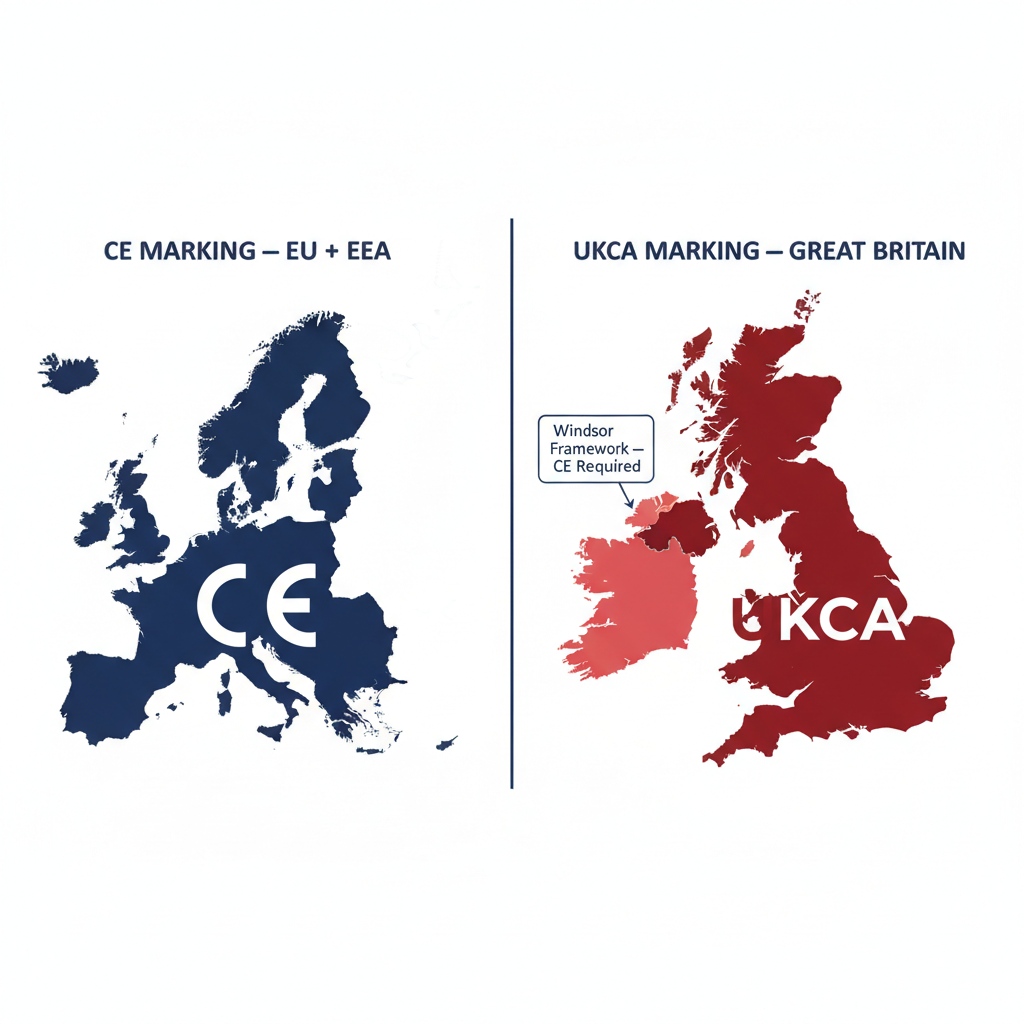
The CE mark (from the French "Conformite Europeenne," meaning European Conformity) is a mandatory compliance mark for products placed on the EU market. It is not a quality or safety endorsement from a third party. Instead, it is a manufacturer's declaration that the product meets all applicable EU directive requirements. Think of it as a legal self-declaration backed by test evidence, not a seal of approval from an external organisation.
1. Low Voltage Directive (LVD) 2014/35/EU: Applies to electrical equipment designed for use with a voltage rating of 50 to 1,000V AC or 75 to 1,500V DC. A standard USB-C PD module operating at 5V to 20V output from a 100-240V AC input clearly falls within this scope. It requires protection against electrical shock, fire, and mechanical hazards.
2. EMC Directive 2014/30/EU: Ensures that your power module does not produce radio frequency interference that disrupts nearby electronics (emissions), and that it continues to function correctly when exposed to interference from other devices (immunity).
3. EU Ecodesign Regulation 2025/2052: Sets minimum energy efficiency requirements for external power supplies and embedded charging modules. Your module must meet specific standby power limits (typically below 0.5W) and active-mode efficiency benchmarks.
UKCA Marking: The Post-Brexit UK Compliance Framework
UKCA stands for UK Conformity Assessed. It was introduced after the UK left the European Union in 2021 to replace CE marking for products placed on the Great Britain market (England, Scotland, and Wales). Northern Ireland follows different rules under the Windsor Framework.
In practical terms, UKCA and CE requirements are largely parallel. An IEC 62368-1:2023 test report generated for CE purposes is almost entirely transferable to UKCA, because the UK adopted BS EN 62368-1:2023 as its corresponding designated standard. The main difference is the paperwork: UKCA requires a separate UK Declaration of Conformity (UK DoC) that references UK-designated standards (BS standards) rather than EN standards, and the UKCA mark itself must be physically applied to the product.
In February 2025, the UK government confirmed that CE marking will be permanently recognised for most product categories on the Great Britain market, with no end date. This means that for the vast majority of furniture power accessories, manufacturers do not strictly need UKCA to sell in Great Britain if they already hold CE certification. However, obtaining dual certification proactively remains a strong recommendation for high-volume, multi-year supply agreements to demonstrate absolute compliance credibility.
The Key Technical Standards You Must Know
IEC 62368-1:2023 - The Core Safety Standard
IEC 62368-1:2023 (adopted in Europe as EN IEC 62368-1:2020 + A11:2020, and in the UK as BS EN 62368-1:2023) is the primary safety standard for audio/video, information, and communication technology equipment. It replaced the older IEC 60950-1 and is now the mandatory reference for USB power modules intended for CE certification. Key test parameters include dielectric strength (hi-pot test), leakage current, creepage and clearance distances, and temperature rise under maximum load.
EN 55032 and EN 55035 - EMC Emission and Immunity
EN 55032 specifies the maximum levels of radio frequency emissions that a product can produce. EN 55035 specifies the minimum immunity levels a product must achieve. Failing conducted emissions is the most common EMC failure mode for switch-mode power supplies, and it can usually be addressed by improving EMC filter design on the PCB.
EU Ecodesign Regulation 2025/2052 - Energy Efficiency
Sets Minimum Energy Performance Standards (MEPS) for external power supplies and embedded power modules. Active-mode efficiency must meet or exceed a calculated threshold (approximately 87-90% for 20-100W units), and no-load power consumption must remain below 0.3W. New module designs submitted for certification after March 2026 must comply fully.
The Step-by-Step Dual Certification Roadmap
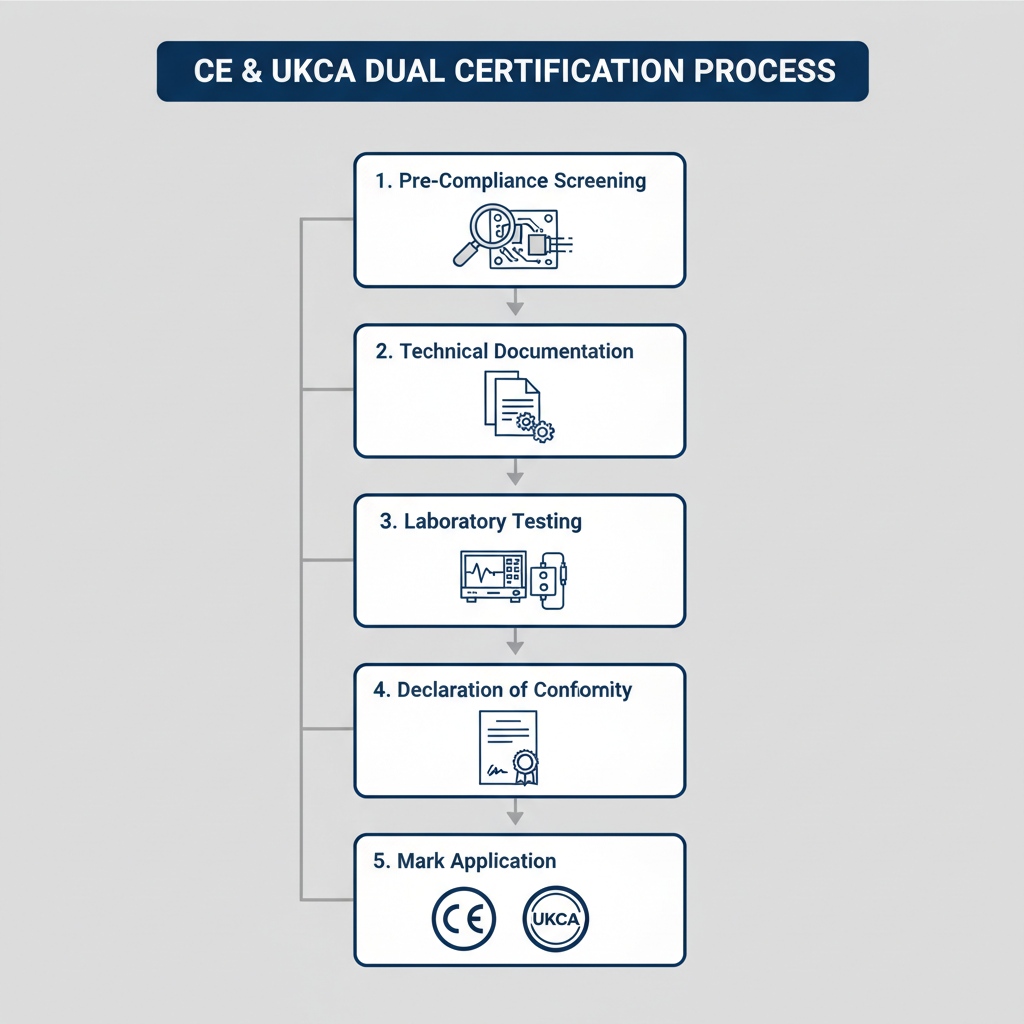
Whether you are a furniture manufacturer integrating an OEM module, or a brand developing your own proprietary USB accessory, the timeline from start to finish is typically 8 to 12 weeks for a new product.
Pre-Compliance Screening (Week 1-2)
Before formal laboratory testing, conduct pre-compliance screening. A preliminary safety review by a qualified engineer should check creepage and clearance distances against IEC 62368-1 tables. Catching design issues at this stage saves thousands of Euros in retesting fees.
Technical Documentation Compilation (Week 2-3)
The LVD and EMC directives require a Technical File to be maintained for 10 years. This must include: full product description, list of harmonised standards applied, circuit diagrams, BOM, risk assessment, and test reports.
Accredited Laboratory Testing (Week 3-7)
Submit product samples to a test laboratory holding both ILAC (for EU) and UKAS (for UK) accreditation. This allows parallel CE and UKCA testing simultaneously on the same samples, saving 2 to 4 weeks.
Declaration of Conformity and Marking (Week 8-10)
Draft and sign the EU DoC and the UK DoC as separate documents. The EU DoC references EN standards; the UK DoC references UK-designated BS standards. Affix both marks to the product packaging.
Post-Market Surveillance Readiness
EU market surveillance authorities (like RAPEX) conduct spot checks. Maintaining updated technical files, keeping test reports current, and monitoring regulatory updates is a continuous obligation.
Common Certification Mistakes Furniture OEMs Make
After assisting dozens of furniture manufacturers and module suppliers, GLOB-EL's compliance team has identified the five most costly mistakes:
If you change a component (e.g., replacing a capacitor), the technical file must be updated and retesting may be required. Shipping modified products invalidates the original CE mark.
Using reports from non-ILAC-accredited laboratories dramatically increases the risk of market surveillance failure and customs holds.
Products that passed efficiency tests in 2023 or 2024 may not meet the new 2026 thresholds without redesign. Ensure your tests align with the latest regulation.
The Radio Equipment Directive (RED) applies to Wi-Fi/Bluetooth devices. A wired USB power module is governed by the LVD and EMC directives. Using a RED DoC is a compliance error.
Non-EU manufacturers must appoint an EU AR whose contact details appear on the product packaging and in the EU DoC. GLOB-EL maintains a qualified EU AR in Germany.
Certification Comparison: CE vs UKCA at a Glance
| Attribute | CE Marking (EU) | UKCA Marking (Great Britain) |
|---|---|---|
| Market Coverage | EU 27 member states + EEA | England, Scotland, Wales |
| Northern Ireland | Required (Windsor Framework) | Not accepted in NI |
| Primary Safety Standard | EN IEC 62368-1:2020 + A11:2020 | BS EN 62368-1:2023 |
| EMC Standard | EN 55032 / EN 55035 | BS EN 55032 / BS EN 55035 |
| 2026 Policy Update | Ecodesign 2025/2052 takes effect | CE marking permanently recognised |
For furniture manufacturers who do not want to manage the certification process themselves, selecting a power module from a supplier who already holds dual CE and UKCA certification is the most cost-effective solution.
All GLOB-EL USB power modules for the furniture market hold CE marking under LVD and EMC directives, with test reports from ILAC-accredited laboratories. Selected models are additionally UKCA marked. GLOB-EL provides full technical documentation packages to OEM partners, reducing your compliance workload significantly.
FAQ: CE and UKCA Certification for Furniture Power
Verifiable Facts and Authoritative References
Low Voltage Directive 2014/35/EU requires CE marking for electrical equipment (50-1,000V AC or 75-1,500V DC).
UK government confirmed permanent recognition of CE marking for Great Britain market in February 2025 (UK DBT).
IEC 62368-1:2023 replaced IEC 60950-1:2005 and IEC 60065:2014 for IT and AV equipment safety.
EU Ecodesign Regulation 2025/2052 sets standby power limits below 0.5W.
Under the Windsor Framework, Northern Ireland requires CE marking.
The DoC must be kept available for market surveillance for 10 years (LVD 2014/35/EU, Article 7).
Non-EU manufacturers must appoint an EU Authorised Representative (LVD 2014/35/EU, Article 10).
This article was prepared by the GLOB-EL Technical Editorial Team, composed of electrical engineers and compliance specialists with combined experience of over 60 years in power module design, EU/UK regulatory compliance, and furniture industry certification.
GLOB-EL (founded 1990) is a leading manufacturer of smart electrical solutions for the furniture industry, specialising in USB fast-charging modules, GaN power solutions, and trunking systems. Serving distributors in over 40 countries across the EU, UK, and North America.
For OEM certification support, visit: www.glob-el-power.com/contact


