


What Rail & Bus Buyers Should Ask a USB Charging module Supplier Before Spec
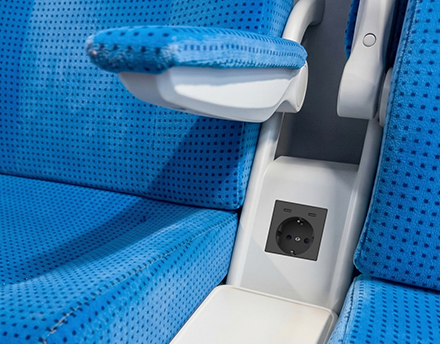
A USB charging port on a train or a bus looks the same as one in an office: a slot, a logo, a cable inserted by a passenger. But the electronics behind that slot are a different product category. Rail and bus interiors run continuously, vibrate, see wide temperature swings, and are governed by strict fire and EMC rules that an office module is not built to meet. Specifying a passenger-facing charging point without asking the right questions up front is one of the most common reasons a project runs late or fails acceptance.
This guide lists the practical questions a rail or bus buyer should ask a usb charging module supplier before locking the specification. It is written for vehicle interior buyers, OEM engineering teams, and train and bus fit-out contractors who need a procurement checklist, not a sales pitch.
Rail and bus charging modules must be qualified for vibration, wide temperature range, fire performance, and vehicle-grade EMC — office modules rarely are.
The specification should ask for test reports, not declarations: vibration, fire, EMC, and input voltage range.
Long-term supply, customization depth, and MOQ matter more in rail than in consumer electronics, because vehicle programs run for years.
A usb charging module that passes office standards is not automatically suitable for passenger vehicles.
The right supplier treats the spec stage as a technical dialogue, not a price list handover.
Why Rail & Bus Is a Different Category
Four operating conditions make passenger-vehicle charging module a specialized product:
Vibration and shock. Trains and buses are moving platforms. Modules must survive continuous vibration without loosening terminals or cracking solder joints.
Temperature range. An unair-conditioned coach in summer and a winter service in northern Europe impose a far wider operating band than an office.
Fire performance. Rail vehicle interiors are covered by strict fire and smoke rules for interior materials, including the electronics housed inside them.
Vehicle electrical system. Onboard power is not a clean 230 V wall outlet; it is a fluctuating vehicle bus (typically 12 V, 24 V, or 110 V DC depending on the vehicle), with its own EMC environment.
An office module designed for a steady indoor 230 V supply is not engineered for any of these four conditions. This is why rail and bus buyers treat the module as a vehicle component, not an accessory.
The Questions Buyers Should Ask Before Spec
1. Which Standards Has the Module Actually Been Tested To?
Ask for the specific standards and the actual test reports. At a minimum, expect a safety baseline aligned with IEC 62368-1 for IT equipment. For rail applications, expect references to railway-specific vibration and EMC standards, and fire performance requirements for interior materials. A supplier who only says "certified" without naming the standards is not giving the buyer enough to sign off.
2. What Is the Operating Temperature Range?
Ask for the certified operating temperature range, not the storage range. In rail and bus applications, the electronics live inside a sealed interior panel that heats up in the sun. A module rated for a narrow indoor band will derate or shut down in summer service.
3. How Is Vibration and Shock Handled?
Ask whether the module has been tested to a railway vibration standard, how the PCB and terminals are secured, and what happens over years of constant vibration. Terminal loosening is a common failure mode in moving vehicles, not in offices.
4. What Fire and Smoke Classification Does the Housing Carry?
Rail interior materials are covered by fire and smoke regulations that are stricter than general commercial furniture. Ask for the housing material's fire classification and the supplier's evidence. A standard commercial enclosure is not automatically acceptable inside a passenger saloon.
5. What Input Voltage Range Does the Module Accept?
Ask whether the module is designed for the vehicle's DC bus (12 V / 24 V / 110 V) or expects AC mains. If the vehicle runs on DC, the module or its power stage must be rated for that input, including the voltage dips and spikes typical of vehicle electrical systems.
6. What Are the Commercial Terms for a Long Program?
Rail and bus programs run for years. Ask the supplier's MOQ, lead time, customization depth (housing color, label, interface mix, firmware), and long-term supply commitment. A supplier comfortable with consumer volumes but not multi-year vehicle programs is the wrong fit.
A Quick Checklist
| Question to ask the supplier | Why it matters | What a serious answer looks like |
|---|---|---|
| Which standards has the module been tested to? | Acceptance and homologation depend on it | Names specific standards and offers test reports |
| What is the certified operating temperature range? | Summer heat inside the vehicle | A range matching vehicle interiors, with derating data |
| Has it passed railway vibration and shock testing? | Terminal and solder-joint reliability over years | A railway-grade vibration standard referenced |
| What fire classification does the housing carry? | Rail interior fire and smoke regulations | A named fire class on the housing material |
| What input voltage range does it accept? | Vehicle bus is not a clean mains supply | Rated for the vehicle's DC bus, with spike and dip tolerance |
| What are MOQ, lead time, and long-term supply? | Vehicle programs run for years | Clear numbers and a stated supply commitment |
| Can the housing, label, and interface be customized? | Brand and interior integration requirements | A defined customization path with tooling lead time |
Field Test and Sample Validation
Before a vehicle program signs off, a supplier should be willing to supply engineering samples and support a fit-out trial. The buyer should plan for at least two stages of validation. First, a bench test: the module is powered from a vehicle-grade DC source, loaded to its rated output, and run for extended hours to observe temperature rise, efficiency, and any fault behavior. Second, a fitted trial: the sample is installed in a real interior panel, on the real bench or seat, and subjected to the actual space constraints, cable routing, and access conditions the production units will face.
Suppliers who resist sample trials, who quote a high non-refundable sample fee, or who cannot describe their own test setup are signaling a consumer-volume business model, not a vehicle-program partnership. In rail and bus, the sample stage is not a courtesy — it is where most integration problems are caught, cheaply, before tooling is cut.
Documentation Package for Vehicle Programs
A vehicle program runs on documentation. The buyer should expect the supplier to hand over a controlled file that includes the bill of materials for the exact part number, the safety and EMC test reports for that configuration, the vibration and fire test evidence, the DC input characterization, the expected service-life estimate under stated conditions, and a declared long-term part number. If the supplier cannot commit to a part number that stays stable for the duration of the program, the buyer should assume mid-life engineering changes are coming and negotiate change-control terms before signing.
It is also worth asking how the supplier handles engineering change requests. In consumer electronics, a running change on a chip or a component is normal. In rail, an unannounced change can trigger a re-approval cycle. A supplier that offers a formal change-notification process — and freezes the design after program launch — is behaving like a vehicle-grade partner.
After-Sales and Field Failure Handling
A vehicle program does not end at delivery. A module fails in service, and the buyer needs a defined path: how a field failure is logged, how a replacement is shipped, and how root-cause analysis is reported back. In rail, a module sitting in a broken seat generates a service complaint; in bus, it generates passenger feedback. The supplier's after-sales process should match the program's response-time expectations, not the supplier's default consumer RMA workflow.
Ask the supplier how many years of after-sales support they commit to for the part, what warranty terms they offer, and whether they can ship replacement units within the agreed window. These are commercial questions, but they directly affect the buyer's cost of ownership over a multi-year vehicle life. A cheap unit with slow replacement support can be more expensive over five years than a slightly higher-priced unit with a committed service level.
Common Pitfalls to Avoid
| Pitfall | Consequence |
|---|---|
| Specifying an office module without checking vehicle standards | Fails acceptance; late redesign |
| Accepting "certified" without test reports | No evidence at homologation time |
| Ignoring the DC bus input requirement | Module does not survive vehicle electrical conditions |
| Choosing the lowest unit price | Field failures under vibration; expensive recalls |
| No long-term supply agreement | Supplier discontinues the part mid-program |
For EU-facing products, the underlying electronics should still meet the baseline expectations common to any commercial usb charging module: safety aligned with IEC 62368-1, relevant EMC compliance, and alignment with ecodesign requirements such as Regulation (EU) 2019/1782. The railway-specific standards then sit on top of this baseline.
Buyers who take a procurement approach rather than a shopping approach consistently end up with suppliers who treat the project as a long-term partnership. The distinction is subtle: a shopping approach asks for the cheapest unit that meets a spec sheet; a procurement approach asks who can support the program for its full life. In rail and bus, that second supplier is usually the one who answers the seven questions above in writing, with test reports attached, rather than verbally on a sales call.
Summary
Rail and bus buyers should not treat a passenger charging point as a generic consumer accessory. The right supplier is identified by test reports, not slogans: vibration qualification, wide-temperature rating, fire-classified housing, vehicle-grade input tolerance, sample-trial cooperation, change-control discipline, and an after-sales process matched to the program's life. Asking the seven questions above before locking the specification separates suppliers who can support a vehicle program from those who can only ship retail boxes. The earlier those questions are asked — before tooling, before homologation — the cheaper the answer becomes.
A supplier that answers these questions in writing, with test reports and a clear commercial offer, is worth a sample order. A supplier that deflects, promises, or quotes retail-style lead times is probably not the right long-term partner for a vehicle program, however attractive the unit price looks on the first email.
Sourcing a rail or bus passenger charging module?
Glob-el designs and manufactures vehicle-grade USB charging modules for rail, bus, and public transport interior integrators. Modules are engineered for wide-temperature and vibration-prone environments, with multi-protocol USB-C PD output from 20 W to 140 W, CE and CB alignment, and customization of housing, label, and interface mix to match vehicle interior designs.
Request a Custom QuoteFAQ
Why is rail and bus USB charging different from office charging?
Passenger vehicles vibrate continuously, run over a wide temperature range, and are governed by strict fire and EMC rules. An office module is not engineered for these conditions and will not pass vehicle acceptance.
What temperature range does a vehicle charging module need?
Ask for the certified operating range, not the storage range. It should cover the heated interior of a vehicle in summer service and cold-weather operation in winter, with derating data at the extremes.
What fire standard applies to rail interior materials?
Rail interiors are covered by fire and smoke regulations for interior materials. Ask the supplier for the housing's fire classification and supporting test evidence rather than assuming a commercial enclosure is acceptable.
Can a standard office usb charging module be used in a train?
Usually no. Office modules expect a steady indoor supply and are not qualified for vibration, wide temperature, or the vehicle's DC bus. A vehicle-grade design is required.
What input voltage do vehicle charging modules use?
Vehicle power is typically a 12 V, 24 V, or 110 V DC bus rather than 230 V AC. The module or its power stage must be rated for that DC input, including spikes and dips.
What should I ask about MOQ and lead time?
Because rail programs run for years, ask the supplier's MOQ, sample and production lead times, customization path, and long-term supply commitment before signing the specification.


